THE SHORT ANSWER
Adding electric appliances does not automatically require a service upgrade, but available breaker spaces do not prove adequate capacity either. Have an electrician assess the existing equipment and calculated demand. Depending on the findings, suitable options may include an appropriate charging rate, approved load management or an upgrade, with the final arrangement verified for the actual house and equipment.
Separate the questions hidden in panel upgrade
The phrase can mean replacing an enclosure, increasing circuit space, changing a feeder or upgrading the electrical service. These are not equivalent projects. Ask the electrician which constraint exists and which equipment limits the proposed addition. The condition and compatibility of the existing panel also matter independently of calculated capacity.
The researched EV-charging discussion compared a load manager with a larger service and included the idea of simply avoiding simultaneous appliance use. That question exposes the distinction between a reliable designed control and a household intention. Before choosing an option, define the electrical constraint and the equipment that would enforce any proposed limitation.
Obtain a defensible assessment of demand
Ask what method the electrician will use to evaluate the planned loads under applicable requirements. Provide exact appliance and charging-equipment information, along with planned future additions that are reasonably defined. The sum of breaker handle ratings is not a homeowner substitute for a proper assessment, and empty spaces do not establish unused service capacity.
The historical HUD rehabilitation inspection guide is useful background for evaluating existing electrical equipment and condition, though its old code references should not govern a current design. The modern project still needs a qualified assessment of the actual service, feeders, panel and loads. Keep those findings in writing so competing proposals address the same constraint.
Match EV charging power to actual needs
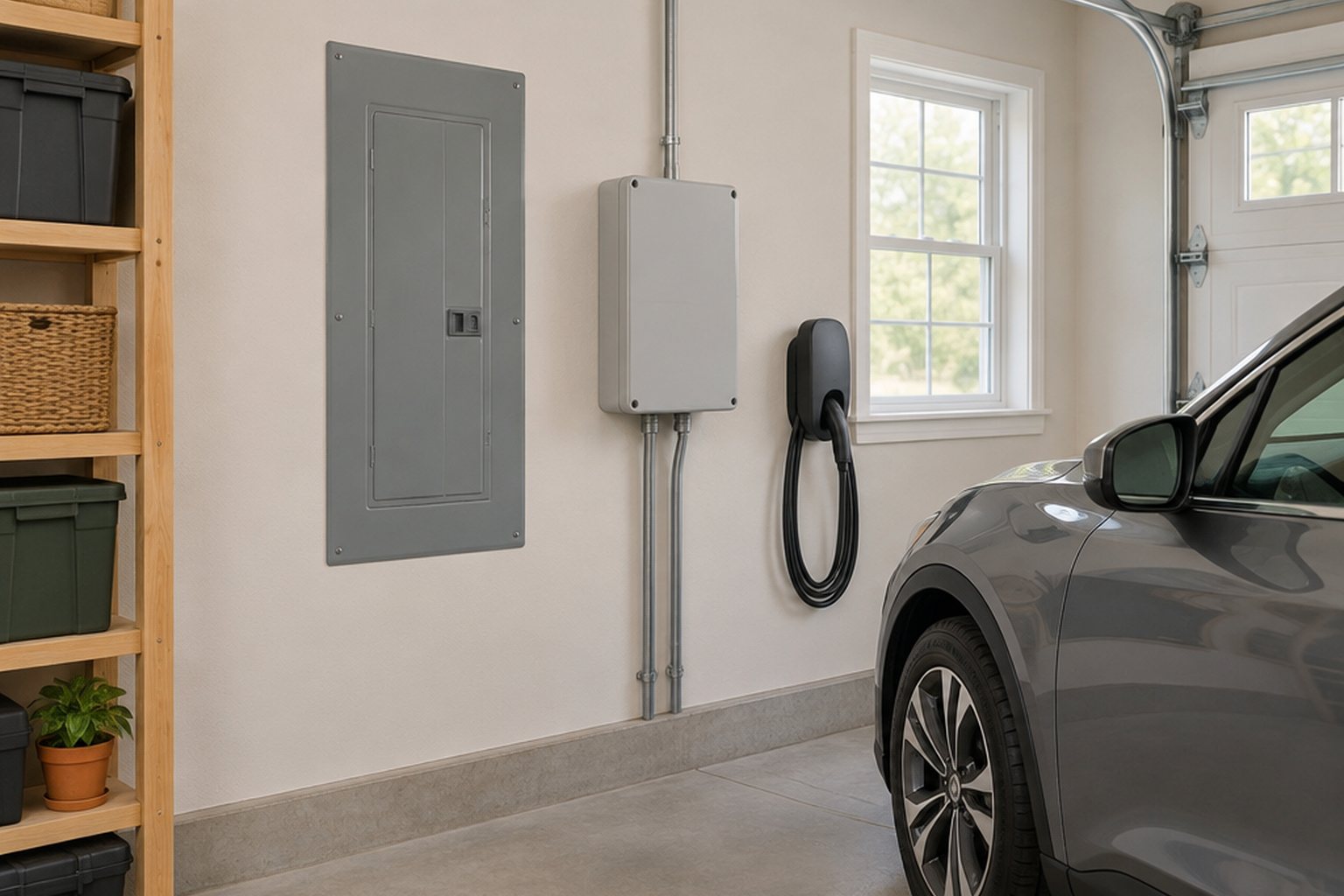
The maximum charging rate a vehicle or charger advertises may exceed what the household needs for ordinary driving and available parking time. Ask the electrician and equipment provider to evaluate an appropriate configured rate within the supported installation. Lower power can be a legitimate design option, but it must be implemented and documented correctly rather than left to an informal promise about use.
Record the vehicle's needs and likely charging schedule without assuming every future vehicle will be identical. The choice involves convenience and capacity, not a universal requirement to install the largest available circuit. A hypothetical owner with long overnight parking may value a different arrangement from one who repeatedly needs short charging windows. The electrical design should reflect the actual use case.
Distinguish static limits from dynamic management
A static configuration limits a device to a selected maximum. Dynamic management adjusts charging in response to monitored available capacity, using supported equipment and controls. Group management coordinates multiple chargers within an allocation and does not necessarily monitor every household load. The functions differ, even when a manufacturer places them under one power-management label.
Tesla's Wall Connector power-management information illustrates these distinctions for its supported configurations. It is a product-specific source, not proof that every charger supports the same features. Ask for the exact compatible meter, controller and charging unit, the installation instructions and the configuration to be commissioned. Product capabilities can change, so the current documentation for the supplied equipment matters.
Evaluate management as an installed safety function
A proposed management system should have a clear measurement location, controlled load and supported response to relevant failures. Ask the installer how loss of communication or another fault is handled under the manufacturer's design. Do not assume a consumer energy-monitoring display can perform the same function as an approved control arrangement.
The CPSC home-wiring hazard guide reinforces the importance of appropriate electrical equipment and qualified assessment. In this context, a promise to remember not to run the oven while charging is not equivalent to a system that reliably enforces the design. The final arrangement needs to satisfy applicable requirements and equipment instructions without depending on every occupant remembering an informal operating rule.
Compare an upgrade with managed alternatives completely
An upgrade may be appropriate because of equipment condition, multiple planned loads, utility constraints or the limitations of available management options. Ask the electrician to explain those reasons. Management may avoid some work in another house, but it does not repair an unsuitable panel or eliminate every infrastructure issue.
Compare complete scopes: utility coordination, service or feeder work, trenching or routes, equipment, controls, inspection and restoration where applicable. Also compare operating limitations and maintenance. A lower initial price is meaningful only when the option meets the intended use and provides a supported installation. Avoid treating an online example of a successful load manager as evidence that the same configuration fits your house.
Keep future plans specific
List plausible additions such as a heat pump, induction range or second charging point, and distinguish firm projects from possibilities. Ask what each option accommodates and what further work would still be required. An undefined promise of future-proofing can justify unnecessary spending without producing a verifiable benefit.
For a hypothetical house considering both a charger and later electric heating, evaluating only the charger may miss the combined decision. That does not mean the owner must immediately purchase the largest service available. It means the comparison should show the consequences of the known alternatives so timing and cost can be chosen deliberately rather than discovered during the next remodel.
Verify configuration and document the finished system
At completion, obtain equipment identification, relevant settings, testing and required inspection records. Ask the installer to demonstrate the intended management behavior using approved procedures. A charger beginning a session does not prove that monitoring and limits operate correctly. Keep access to serviceable components and preserve the documentation needed for future equipment changes.
If a charger, major appliance or controller is replaced later, have compatibility and capacity reviewed again. Do not assume the old settings automatically transfer. The useful outcome is a documented electrical arrangement that serves the household's needs and enforces its design limits, whether that involves managed charging, a lower configured rate or a service upgrade.
BEFORE YOU PROCEED
Your project checklist
- Identify whether the constraint is condition, circuit space, feeder or service capacity.
- Provide exact planned appliance and charger information.
- Obtain the applicable demand-assessment basis.
- Distinguish static limits, dynamic management and group coordination.
- Compare complete upgrade and managed-installation scopes.
- Retain commissioned settings and review them after later equipment changes.
Questions that come up next
Does an empty breaker space mean I can add a charger?
No. Physical space and electrical capacity are different questions. The existing equipment, demand and proposed circuit need qualified assessment.
Can I avoid an upgrade by promising not to use appliances together?
An informal routine is not equivalent to an approved system that enforces a limit. Have the electrician identify a compliant supported arrangement for the actual equipment and loads.
EVIDENCE & SCOPE
Sources for this guide
Applies to: United States homeowner education. Climate, existing assembly, manufacturer instructions and locally adopted requirements govern project details; no nationwide code threshold is asserted.
Reddit discussions identify questions and experiences, not verified diagnoses or code requirements. Technical claims should be read with the linked primary source, product instructions and local requirements.
- Residential Rehabilitation Inspection Guidegovernment
Existing-building inspection, structural distress and hidden systems assessment. Historical HUD guide accepted in 2000; inspection background, not a statement of current local code.
- Wall Connector Power Managementmanufacturer
Static, dynamic and group management and the limits of each configuration.
- CPSC Guide to Home Wiring Hazardsgovernment
Overloads, warning signs, electrical shock protection and qualified assessment. Consumer safety guidance, not a complete local electrical design specification.
- Load Manager Vs upgrading service/panelreddit
An anonymized homeowner question that informed the article. Retrieved through search excerpts; anecdotal evidence, not a technical diagnosis.