THE SHORT ANSWER
A ground vapor barrier and full crawl space encapsulation solve different parts of a moisture problem. A liner limits moisture transfer from the ground; a complete conversion also addresses enclosure boundaries, air leakage and humidity control. Neither should begin by trapping unresolved drainage problems underneath a new-looking surface. Compare proposals by diagnosis, complete scope and maintainability.
Start by defining the two proposals
“Vapor barrier” often describes material laid over exposed ground, but the term alone does not tell you how seams, piers and edges will be treated. “Encapsulation” can describe a much wider package, yet companies use it inconsistently. One bid may include drainage and dehumidification; another may mainly include a thicker liner and sealed vents. Ask each company to identify the actual components rather than compare marketing names.
A researched homeowner was told an inspection called for a replacement vapor barrier while several contractors offered only full encapsulation. That disagreement does not prove either side correct. It shows why the homeowner needs the observed conditions translated into a scope before deciding whether the more extensive system is warranted.
Separate liquid water from water vapor
Look for evidence of standing water, soil erosion, plumbing leakage, staining and previous flooding. These are different from moisture vapor moving through exposed ground or humid air entering through openings. PNNL's existing crawlspace water-management guide puts drainage and moisture problems ahead of sealing and insulation. Covering an active liquid-water problem does not make the source disappear.
Ask where collected water will go and whether the discharge arrangement is lawful and effective for the property. A sump, perimeter drain or exterior grading change should answer a specific observed problem. The contractor should explain why it is included and how it will be maintained. A generic package containing every available component is not the same as a design based on your crawlspace.
Understand what a ground liner does
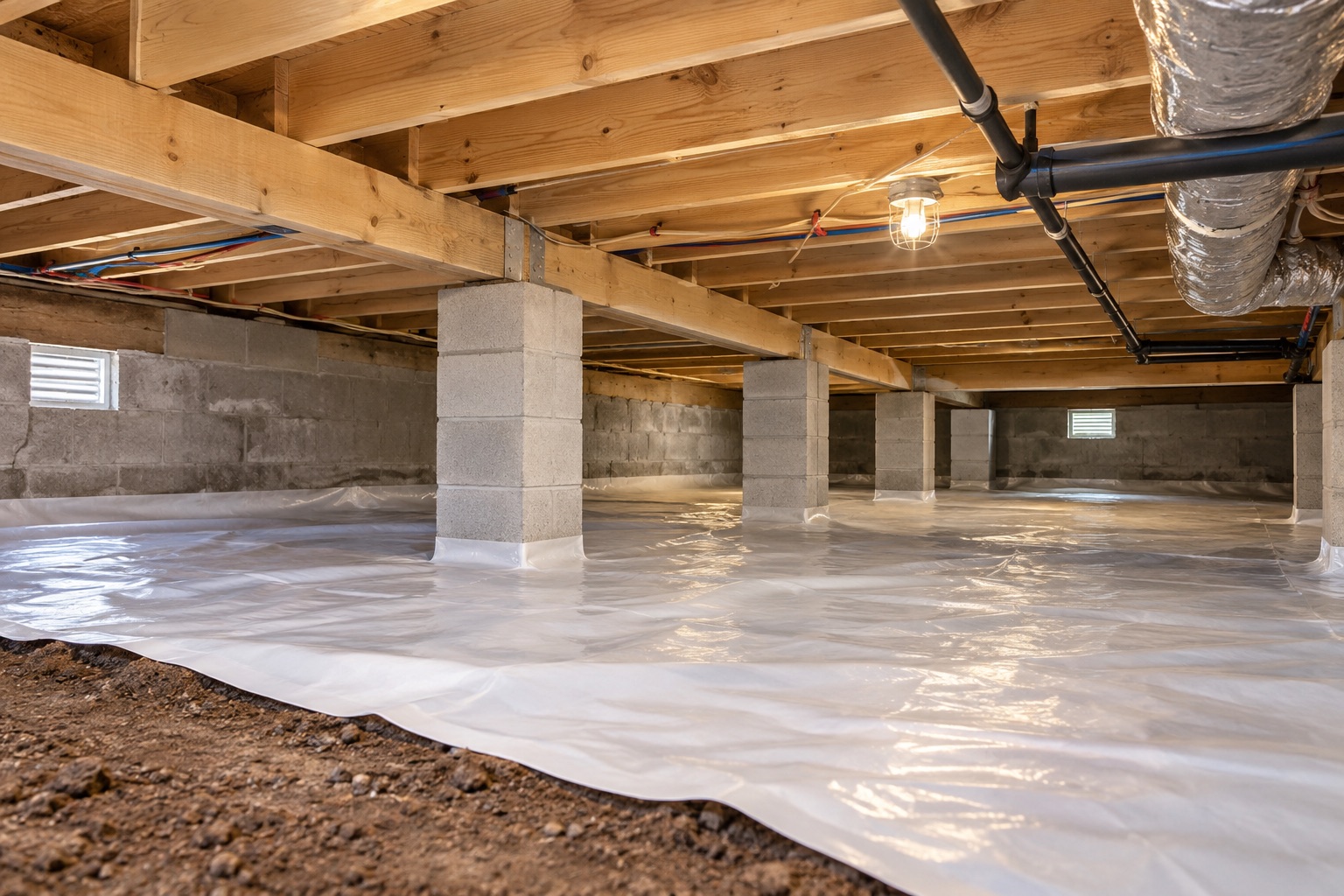
PNNL's crawlspace capillary-break guidance describes separating the building environment from moisture at the ground surface. Continuity matters: a liner interrupted around piers, damaged by storage or left poorly detailed at boundaries may perform differently from the nominal material specification. Ask for an installation plan showing those transitions, not just a material thickness printed on a proposal.
A ground liner does not by itself establish whether the crawlspace should be vented, unvented or conditioned. It also does not automatically correct air leakage through the floor above. Its value should be judged against the actual moisture pathways. A simple properly designed intervention may be appropriate in one house, while another needs a coordinated enclosure change to remain reliably dry.
Evaluate the consequences of changing the enclosure
Closing vents and insulating perimeter walls changes how the crawlspace exchanges heat, air and moisture with outdoors and the occupied home. Existing ductwork, combustion equipment, access doors and utility penetrations therefore belong in the assessment. Do not assume that sealing every opening is appropriate without understanding those systems and the locally accepted design.
Pest inspection provisions also matter, particularly where concealed wood-to-ground relationships or required inspection areas would be covered. Ask how the design preserves access to relevant building components. A liner that looks continuous in a sales photograph may create an inspection or maintenance problem if it conceals connections that need future observation. The final system needs to work for the house's climate, equipment and service requirements together.
Ask how humidity will be managed
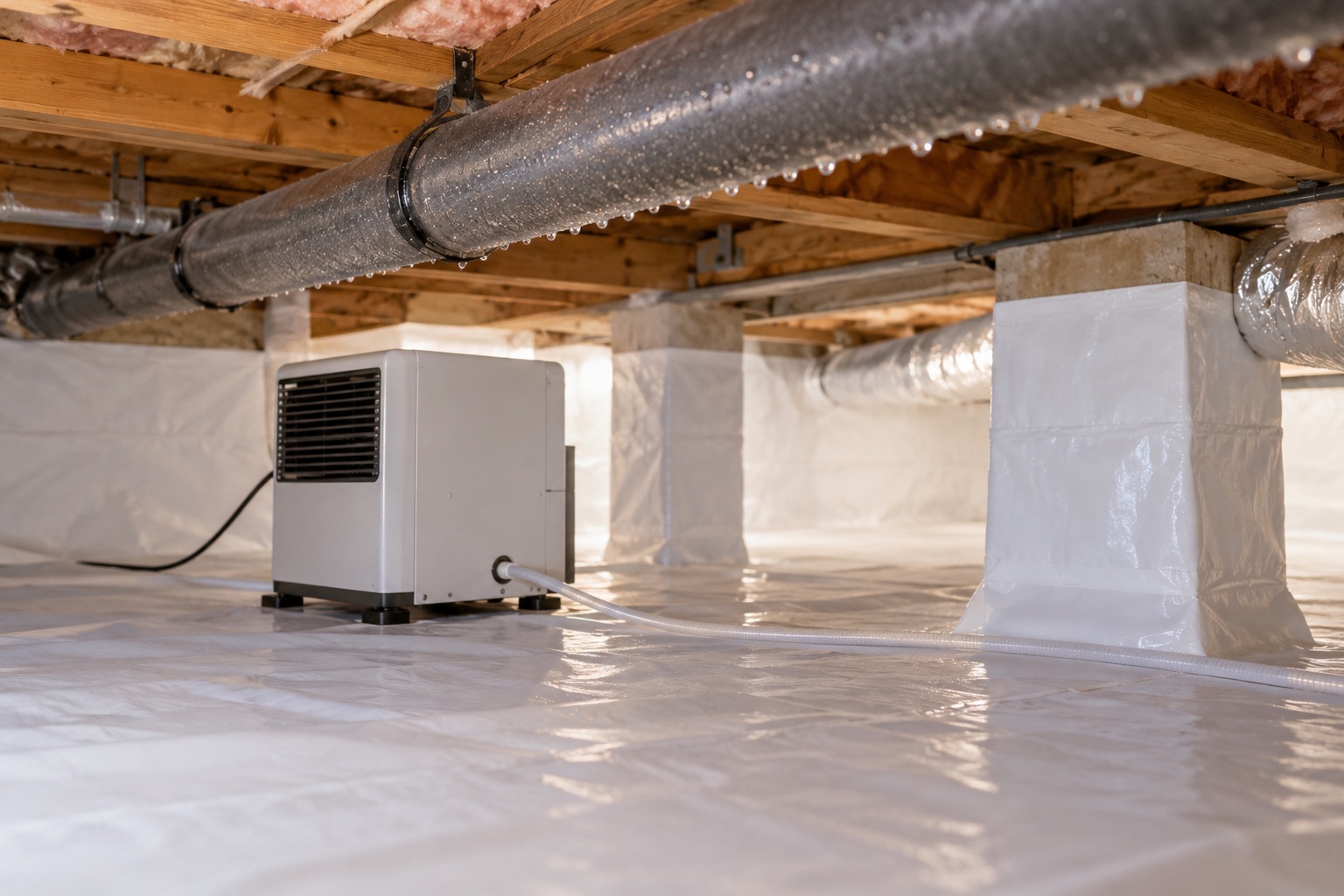
An enclosure conversion needs an explicit moisture-removal strategy. Ask what equipment or air exchange the design relies on, how its operation will be controlled, where condensate drains and what happens when it stops working. A dehumidifier model number alone is not a sizing or maintenance plan. Its accessible filter, service space and discharge route matter as much as the brochure capacity.
PNNL's dehumidification guidance distinguishes moisture removal from temperature control. That distinction helps explain why a cooler crawlspace is not necessarily a dry one. The applicable arrangement may differ from a whole-house example, but the design question remains: which moisture loads are expected, and how will the system remove them under actual conditions rather than only during a brief installation visit?
Compare complete costs and responsibilities
Request proposals with separate lines or descriptions for debris removal, existing insulation removal, source repairs, structural or mold work, drainage, liner installation, perimeter sealing, insulation and humidity equipment. Include access improvements and electrical or plumbing work needed by that equipment. Without this breakdown, the lowest price may simply omit prerequisites that another company has included.
For a hypothetical house with seasonal standing water, a liner-only price cannot fairly be compared with a drainage-and-enclosure conversion. For a dry crawlspace with a damaged ground cover, the larger package should still explain its additional benefit. Ask what existing evidence changes the recommendation. This creates a decision based on conditions rather than an argument over whether encapsulation is universally necessary or universally wasteful.
Inspect the work before it becomes hard to assess
Before accepting the installation, review photographs of corrected defects and inspect accessible liner seams, boundaries, penetrations and access details with the contractor. Confirm that structural concerns were addressed by the appropriate professional and that the chosen materials match the proposal. Do not enter a cramped or hazardous crawlspace simply to perform your own quality-control tour; documentation and qualified inspection can provide safer evidence.
Commission humidity equipment and drainage components under supervised conditions. Ask for initial readings and a practical period of follow-up, recognizing that previously wet materials may take time to dry. A single humidity reading on a mild day cannot establish year-round performance. Clarify what conditions trigger a return visit and which party is responsible.
Choose the scope you can maintain
A successful system is one the owner can inspect, service and understand. Keep a plan showing equipment locations, discharge routes, inspection access and any components that must remain unobstructed. Set a realistic schedule for checking filters, drains and visible damage, based on the installed products. Storage and later trade work can puncture or displace a liner, so future contractors need to know it is part of the moisture-control system.
The decision is therefore broader than initial installation cost. Compare expected maintenance, access, dependence on powered equipment and how failures will be noticed. Select the least complicated complete solution supported by the investigation, while leaving room for a more extensive design when the existing conditions justify it.
BEFORE YOU PROCEED
Your project checklist
- Define exactly what each contractor means by vapor barrier or encapsulation.
- Resolve evidence of liquid-water entry before enclosing the space.
- Review combustion equipment, ductwork and pest inspection access.
- Specify the humidity-removal and condensate-discharge strategy.
- Compare prerequisite repairs and maintenance obligations across bids.
- Document commissioning and follow-up expectations.
Questions that come up next
Is a thicker crawlspace liner always better?
Durability matters, but thickness alone does not establish performance. Drainage, seam and penetration details, substrate preparation, access and humidity management may determine whether the complete system works.
Does every crawlspace need a dehumidifier?
No universal answer fits every climate and enclosure. The designer should explain the moisture-removal strategy for the actual assembly and demonstrate that it can maintain the intended conditions.
EVIDENCE & SCOPE
Sources for this guide
Applies to: United States homeowner education. Climate, existing assembly, manufacturer instructions and locally adopted requirements govern project details; no nationwide code threshold is asserted.
Reddit discussions identify questions and experiences, not verified diagnoses or code requirements. Technical claims should be read with the linked primary source, product instructions and local requirements.
- Water Management of Existing Crawlspace Floorgovernment
Bulk-water correction before crawlspace sealing; ground vapor control, drainage and moisture management. Technical guidance; local requirements and product-specific details vary.
- Capillary Break at Crawlspace Floorsgovernment
Ground vapor barrier purpose, continuity, piers and liquid-water limitations. Technical guidance; local requirements and product-specific details vary.
- Whole-House Dehumidificationgovernment
Sensible versus latent loads, equipment selection and supplemental dehumidification. Technical guidance; local requirements and product-specific details vary.
- vapor barrier or encapsulation for crawlspace?reddit
An anonymized homeowner question that informed the article. Retrieved through search excerpts; anecdotal evidence, not a technical diagnosis.
- Crawl space encapsulationreddit
An anonymized homeowner question that informed the article. Retrieved through search excerpts; anecdotal evidence, not a technical diagnosis.