THE SHORT ANSWER
Water at a deck ledger can affect both the deck attachment and the house framing behind it. Replacing visible boards or adding sealant may leave the consequential condition hidden. Have a qualified professional assess the complete connection, drainage detail and material condition. Keep a questionable elevated deck out of use when advised or when obvious distress suggests an immediate hazard.
Understand what the ledger connects
The ledger is the member that can connect an attached deck to the house, transferring loads through its attachment into suitable house structure. Its performance depends on more than the visible board. The receiving framing, fasteners, lateral connections and surrounding material condition all matter. A neat outer surface cannot establish that those concealed elements are sound.
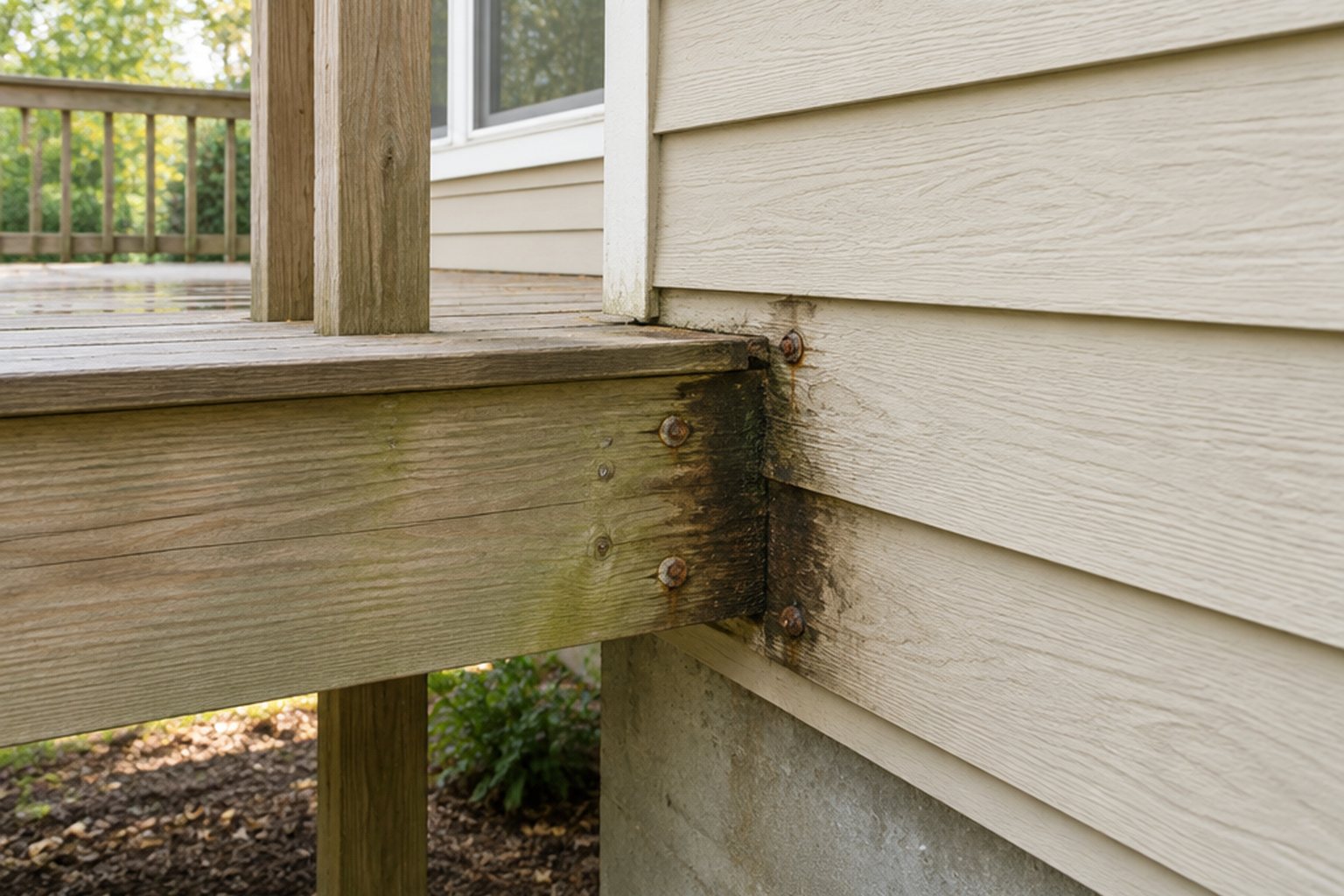
The researched owner noticed an elevated deck ledger getting wet where flashing stopped short. That observation raised a reasonable question about hidden rim-joist damage, but it did not prove either structural failure or harmlessness. The correct next step is a connection and moisture assessment, not an improvised fastening pattern or a cosmetic patch chosen from a photograph.
Assess use restrictions before investigating closely
Visible separation from the house, pronounced movement, damaged supports or other obvious distress can make a deck unsafe to occupy. Do not load the deck with people to demonstrate the problem or crawl beneath questionable framing. Obtain appropriate professional advice and restrict use where the condition warrants it. The investigation should not create additional exposure.
An elevated deck has consequences different from a loose decorative trim board at ground level. That does not justify declaring every wet ledger an imminent collapse, but it does justify a proportionate structural assessment. Tell the professional about the deck's height, normal use, any movement and the history of alterations or leaks. These details help determine the urgency and inspection scope.
Follow water behind the visible surfaces
Ask how the ledger flashing connects with the wall's drainage layers and how water is directed outward. End conditions, penetrations and transitions can be important, especially where water concentrates at one corner. A top bead of sealant does not by itself explain the full path, and covering a wet connection can make later inspection harder.
The Simpson Strong-Tie deck connection guide addresses deck-specific attachment details and deficiencies. Use the relevant deck guidance rather than borrowing a window-flashing diagram as if it designed the ledger. The actual assembly needs a compatible detail suited to the wall, deck and exposure, with its relationship to the structural connection understood.
Evaluate hidden receiving material
The board visible from the deck may be easier to replace than deteriorated house framing behind it. Ask what evidence establishes the condition of the receiving rim or other support and whether selective access is necessary. Moisture readings can guide investigation, but they do not independently determine remaining load capacity or the adequacy of hidden connections.
The historical HUD rehabilitation inspection guide is useful background for evaluating existing structural and exterior conditions together. Its dated code references are not a current deck specification. The practical question is what material remains capable of performing its structural role. If that cannot be established visually, the professional should explain the additional investigation or design needed rather than assume the outer ledger tells the whole story.
Review the entire deck load path
The ledger is only one part of the structure. Posts, beams, joists, footings, bracing, guards and their connections may require assessment as well. A focused leak complaint can reveal one defect without establishing that the rest of an older deck has been checked. Ask the inspector to define the scope and identify any consequential limitations.
Do not add fasteners or substitute hardware based only on a generic diagram. Connector selection, receiving material, edge conditions and the intended loads interact. A solution suitable for one house may be inappropriate for another wall or floor system. The owner should receive an understandable explanation of the proposed connection, while the technical design remains with the qualified professional responsible for it.
Include corrosion and product compatibility
Outdoor moisture, treated wood and coastal exposure can affect metal components. Ask the designer or installer to identify suitable connectors and fasteners as a supported combination for the actual conditions. A fastener that physically fits a hole is not automatically an acceptable substitute. Mixing incompatible components can undermine an otherwise thoughtful repair.
Consider a hypothetical ledger with sound framing but unsuitable corroded connections. Its repair differs from a ledger attached to significantly deteriorated receiving wood. Another deck may need a different support strategy because the house connection cannot be verified appropriately. These are distinct structural conditions, so comparing only the number of new bolts or the length of replacement lumber is not a meaningful scope comparison.
Plan access, temporary support and weather protection
The repair may require opening cladding, removing deck components or temporarily supporting part of the structure. Those procedures should be designed and performed by competent professionals, not improvised from a homeowner article. Ask who is responsible for the temporary condition and how unexpected deterioration is evaluated before work proceeds.
Coordinate water-management restoration with the structural repair. A sound new connection can still be exposed to the same wetting mechanism if flashing and wall interfaces are left unresolved. Conversely, a tidy flashing repair does not restore deteriorated structural material. The proposal should describe both functions and identify the photographs or inspections needed before finishes conceal them again.
Accept the repair with a connection record
Before closure, obtain relevant photographs of receiving material, installed connections and drainage details. Retain the design or manufacturer's applicable installation information and required inspection records. Ask how the completed work was checked against that basis and how any deviations were resolved. A freshly stained deck surface is not meaningful evidence of hidden attachment quality.
Keep a maintenance plan that includes accessible connections, drainage and signs of renewed wetting or movement. Inspect after relevant weather and following later alterations that could affect the wall or deck. A successful repair makes the structural and water-management logic clear enough for future professionals to understand, rather than leaving another concealed assembly whose history must be guessed from the outside.
BEFORE YOU PROCEED
Your project checklist
- Document deck height, movement and visible connection distress.
- Restrict use appropriately when structural safety is in question.
- Assess flashing continuity and hidden house receiving material.
- Review the complete deck load path and inspection limits.
- Specify compatible connectors and fasteners for the exposure.
- Retain pre-concealment photographs and design-conformance records.
Questions that come up next
Can I solve ledger leakage with a bead of caulk?
Only a verified detail can establish the appropriate repair. Sealant alone may leave the water path or hidden damage unresolved, and the structural attachment needs assessment separately.
Does replacing the ledger prove the deck is safe?
No. The receiving house framing and the rest of the deck's supports and connections also matter. Define the inspection and repair scope rather than assuming one replacement certifies the whole structure.
EVIDENCE & SCOPE
Sources for this guide
Applies to: United States homeowner education. Climate, existing assembly, manufacturer instructions and locally adopted requirements govern project details; no nationwide code threshold is asserted.
Reddit discussions identify questions and experiences, not verified diagnoses or code requirements. Technical claims should be read with the linked primary source, product instructions and local requirements.
- Deck Connection and Fastening Guidemanufacturer
Deck ledger, post, joist and lateral connections; corrosion and deficiencies.
- Residential Rehabilitation Inspection Guidegovernment
Existing-building inspection, structural distress and hidden systems assessment. Historical HUD guide accepted in 2000; inspection background, not a statement of current local code.
- Wet Ledger Board, concern for rot and damagereddit
An anonymized homeowner question that informed the article. Retrieved through search excerpts; anecdotal evidence, not a technical diagnosis.