THE SHORT ANSWER
Decide whether to stay during a remodel by testing the household's actual daily needs against the work sequence. Plan safe access, essential facilities, utility interruptions, deliveries and a place to retreat from disruptive work. Agree on notice and temporary relocation triggers before construction. Technical containment and hazard controls require their own project-specific assessment; a convenient temporary kitchen does not make an unsafe occupied area acceptable.
Map a normal day before drawing work zones
List how the household enters, sleeps, cooks, washes, works and leaves in an emergency. Include children, pets, mobility needs and anyone who depends on medical equipment or a predictable quiet environment. Compare those routines with the proposed construction area and access path. A family may be able to manage without its main kitchen while still needing a reliable bathroom and unobstructed exit. Another household may find the same arrangement impractical. Do not decide from the project label alone. The useful question is whether essential routines can operate safely and consistently through each stage, including the most disruptive period rather than only the finished-condition plan.
Agree on the household and construction boundary
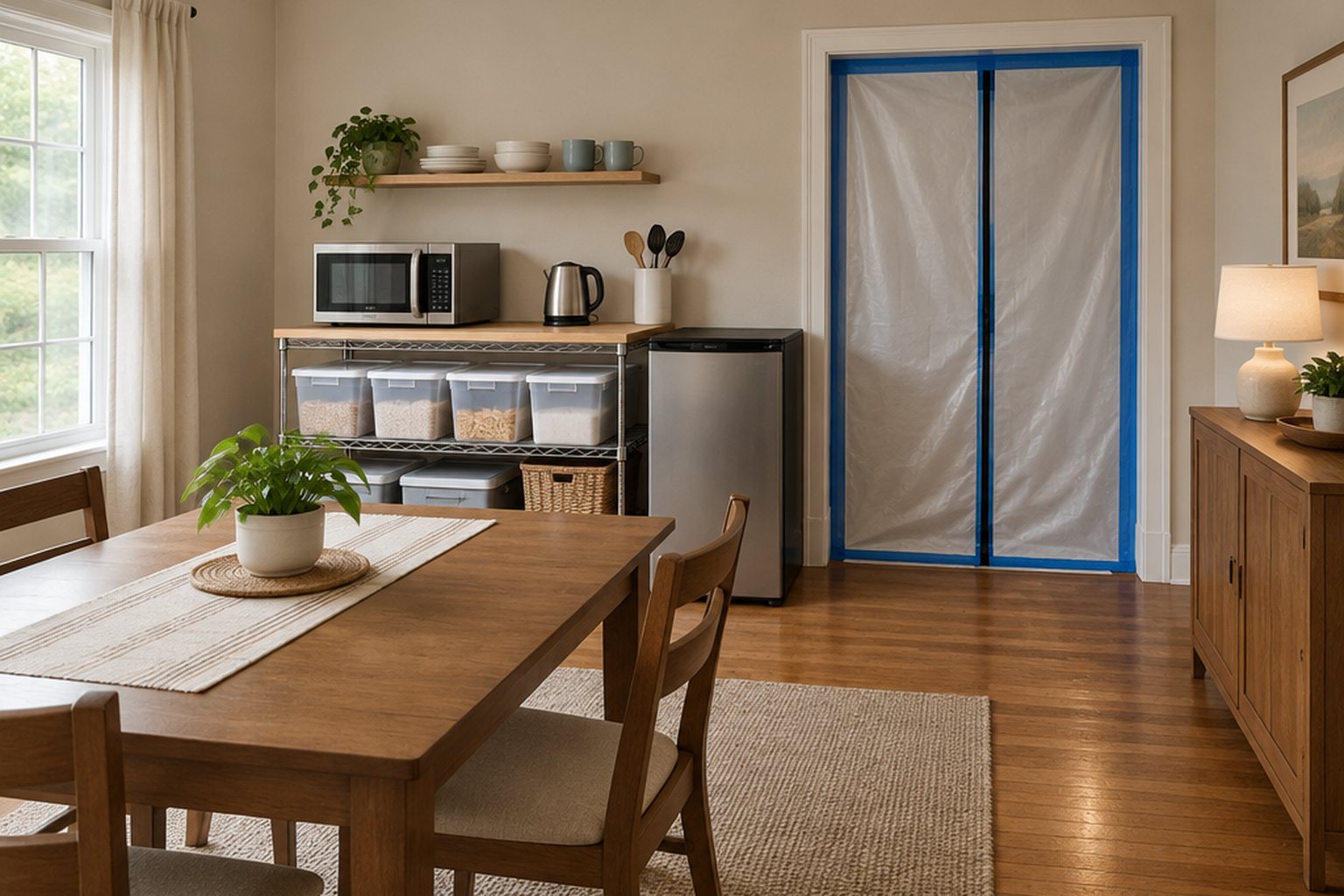
Identify which rooms remain occupied, which areas are restricted and how workers, materials and waste reach the work area. Decide where keys, access codes and deliveries are managed. Keep private rooms and stored belongings outside the agreed work scope where possible. The boundary also needs technical review: the EPA's remodeling guidance discusses source control and separation of work activities from occupied areas. This article addresses the household workflow, not a specification for containment equipment. Ask the contractor or relevant specialist to explain the protection plan and its limitations. A line on a floor plan does not by itself establish that air, dust or other hazards stay on one side.
Plan essential services by stage
Ask when water, power, heating, cooling, cooking facilities or bathrooms will be unavailable and what notice is practical. Identify a fallback for each essential service and who confirms that it can be used. Temporary arrangements should be appropriate for the household and the available infrastructure; do not improvise overloaded electrical supplies or unsafe cooking locations. If a shutoff may affect equipment or a resident's health needs, plan that issue explicitly with the relevant professionals. A schedule note that utilities may be interrupted is insufficient for day-to-day living. Record the expected disruption, preparation steps and person responsible for notifying the owner of a change.
Define access and availability without becoming site staff
Living in the house does not require the owner to supervise trades continuously or receive every delivery. Agree on work hours, entry arrangements, parking and any times when access is unavailable. Identify decisions requiring an owner visit and those that can be made from complete documents. Keep a practical contact route for unexpected conditions. If someone works from home, discuss noise-sensitive meetings and realistic limits rather than promising silence during demolition. The contractor may be unable to accommodate every preferred time, so compare the disruption with temporary alternatives before work begins. Clear expectations reduce resentment when construction and household routines inevitably compete.
Address older-home hazards before relying on occupancy
The Reddit discussion informing this topic described dust reaching children's rooms during work in an old house. It illustrates why occupancy cannot be judged from convenience alone. The EPA's lead renovation program identifies requirements and safe-work concerns for covered paid renovation, and the current compliance guide provides further detail for firms. Ask what assessment and qualified work arrangements are needed before disturbance. Do not use a household cleaning routine or an unverified test as assurance that a contaminated area is safe. If the protection plan fails or an unexpected hazard is found, reassess the work and occupancy with the appropriate professionals.
Agree on relocation triggers and practical logistics
Identify conditions that require the household to leave a room or the property temporarily: loss of essential sanitation, unsafe access, protection failure or professional direction related to a hazard. The exact triggers depend on the project and residents, so avoid a universal list that pretends to settle every case. Decide where people and pets can go, what must be taken and who gives the all-clear for return. Consider short-notice arrangements as well as planned relocation. Keep the financial responsibility consistent with the agreement and insurance terms; do not assume the contractor or insurer automatically pays every temporary accommodation expense.
Use a daily reset and a weekly household review
Agree on how the work area is left at the end of the day: access routes available, tools and openings controlled, waste arrangements maintained and essential services identified. The technical safety standard belongs to the project team, but the owner should know how to report a concern and who responds. At the weekly update, review the next disruptive activities and any change to household arrangements. A brief checklist can prevent avoidable surprises such as a morning delivery blocking the only usable exit route. It should support the contractor's responsibilities, not shift professional site-safety management onto a homeowner who happens to be present.
Reassess whether staying remains worthwhile
An occupied-work plan can be reasonable at the start and become unsuitable after scope changes or a resident's needs change. Compare the remaining disruption with the cost and feasibility of moving temporarily, without treating persistence as a point of pride. Keep the discussion factual: services available, routes usable, protection effective and expected duration of the difficult stage. If the answer to a critical question is uncertain, resolve it before assuming the household can continue as before. A successful occupied remodel is one in which daily arrangements adapt to verified conditions, and everyone understands when convenience must give way to a different living plan.
BEFORE YOU PROCEED
Your project checklist
- Map essential household routines and exit routes.
- Agree on restricted and occupied areas.
- Plan service interruptions and fallback arrangements.
- Set access and advance-notice expectations.
- Address hazard assessments before disturbance.
- Define relocation and return-to-use decisions.
Questions that come up next
Can children stay in the house during renovation?
It depends on the work, hazards, protection plan and available occupied space. Obtain project-specific assessment rather than assuming that a separate bedroom alone makes occupancy safe.
Should I supervise workers because I am home?
Being present does not make you the site supervisor. Agree on access and decision responsibilities while keeping professional construction and safety duties clear.
EVIDENCE & SCOPE
Sources for this guide
Applies to: United States safety planning; local occupancy rules and authorized lead programs vary.
Reddit discussions identify questions and experiences, not verified diagnoses or code requirements. Technical claims should be read with the linked primary source, product instructions and local requirements.
- EPA: Best Practices for Indoor Air Quality when Remodeling Your Homegovernment
EPA remodeling guidance on indoor air quality, underlying moisture problems, work separation, ventilation and hazardous-material considerations.
- EPA: Lead Renovation, Repair and Painting Programgovernment
EPA rules and guidance for covered renovation work disturbing lead-based paint, with applicability and exemption conditions.
- EPA: Small Entity Compliance Guide to Renovate Rightgovernment
EPA landing page for its Renovate Right compliance guide, including renovation-firm responsibilities and prework occupant information.
- Construction with kids in homereddit
Demolition dust escapes into occupied rooms in an old house with young children. Full thread was available during research. Individual experiences are not legal or technical authority.