THE SHORT ANSWER
A new range hood should be designed with its duct route, the house's pressure behavior and any combustion appliances in mind. Makeup-air requirements depend on the applicable rules and installation, so a single online airflow threshold is not a complete answer. Ask the designer to evaluate capture, actual exhaust delivery and replacement air together before ordering the hood.
Define the cooking and capture problem
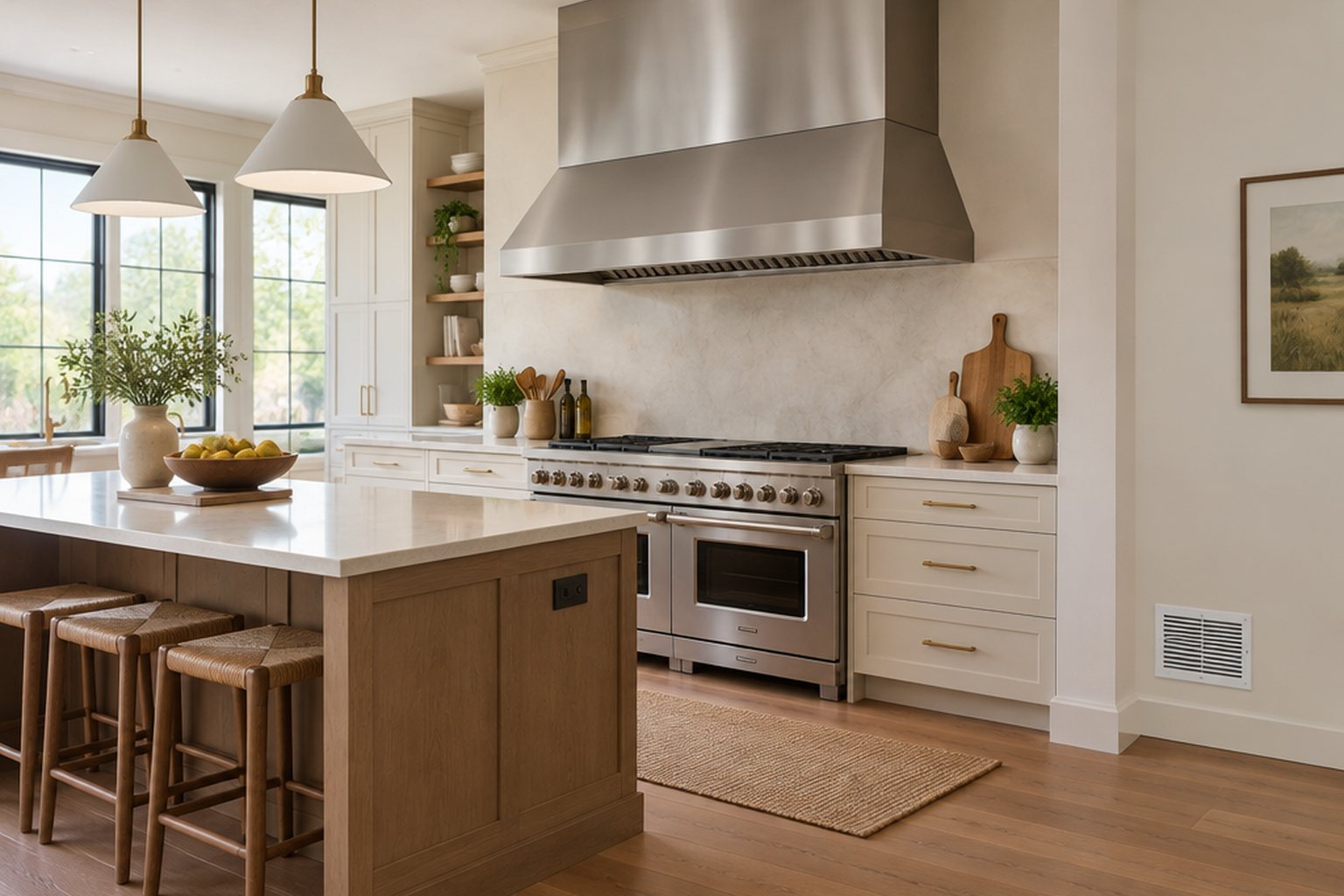
Start with the appliance arrangement and the complaint: lingering odors, visible smoke, grease deposition or poor capture over particular burners. Record the range or cooktop model and the proposed hood position. These details matter more than selecting the largest airflow rating available. A hood needs to capture the cooking plume in its actual installation, not merely move air in a laboratory rating.
The researched discussions included a recirculating kitchen fan and confusion about makeup air for a stronger replacement. They reveal an important planning gap: changing the visible hood can affect systems beyond the cabinets. Treat ventilation as part of the kitchen design early enough to accommodate ducts and replacement-air arrangements before finishes make routes difficult.
Distinguish recirculation from outdoor exhaust
A recirculating device filters and returns air to the room according to its design. A ducted hood sends air outdoors through a defined route. They therefore do not serve identical functions. Ask what the proposed product is intended to remove and which filters or maintenance it requires. Do not assume the word vent on a retail listing confirms an outdoor connection.
PNNL's kitchen-exhaust retrofit guide addresses planning an actual ducted route and coordinating the installation. That is a useful basis for evaluating a retrofit. The practical scope includes more than the hood itself: duct, termination, water-management details, controls and any related building-system work should be visible in the proposal.
Evaluate the duct before increasing rated airflow
Length, diameter, bends and the termination affect the resistance the fan encounters. Ask for the proposed route and the manufacturer's requirements for the selected product. A restrictive path can limit delivered exhaust even when the hood has an impressive nominal rating. Changes to the route or duct should be evaluated rather than hidden behind a higher fan setting.
Discuss noise at the settings occupants will actually use. An installation that is too loud may be switched off or operated below the intended level. Remote equipment or different routing may offer options in some projects, but each has its own requirements. Compare the complete installed arrangement rather than assuming the quietest showroom demonstration predicts the finished kitchen.
Understand why replacement air matters
Air exhausted from a house must be replaced through some combination of intentional supply and uncontrolled leakage. The pressure consequences depend on the enclosure and other systems. A tightly constructed home and an older leaky home can respond differently, but age alone does not establish the outcome. Ask how the designer will assess the actual building.
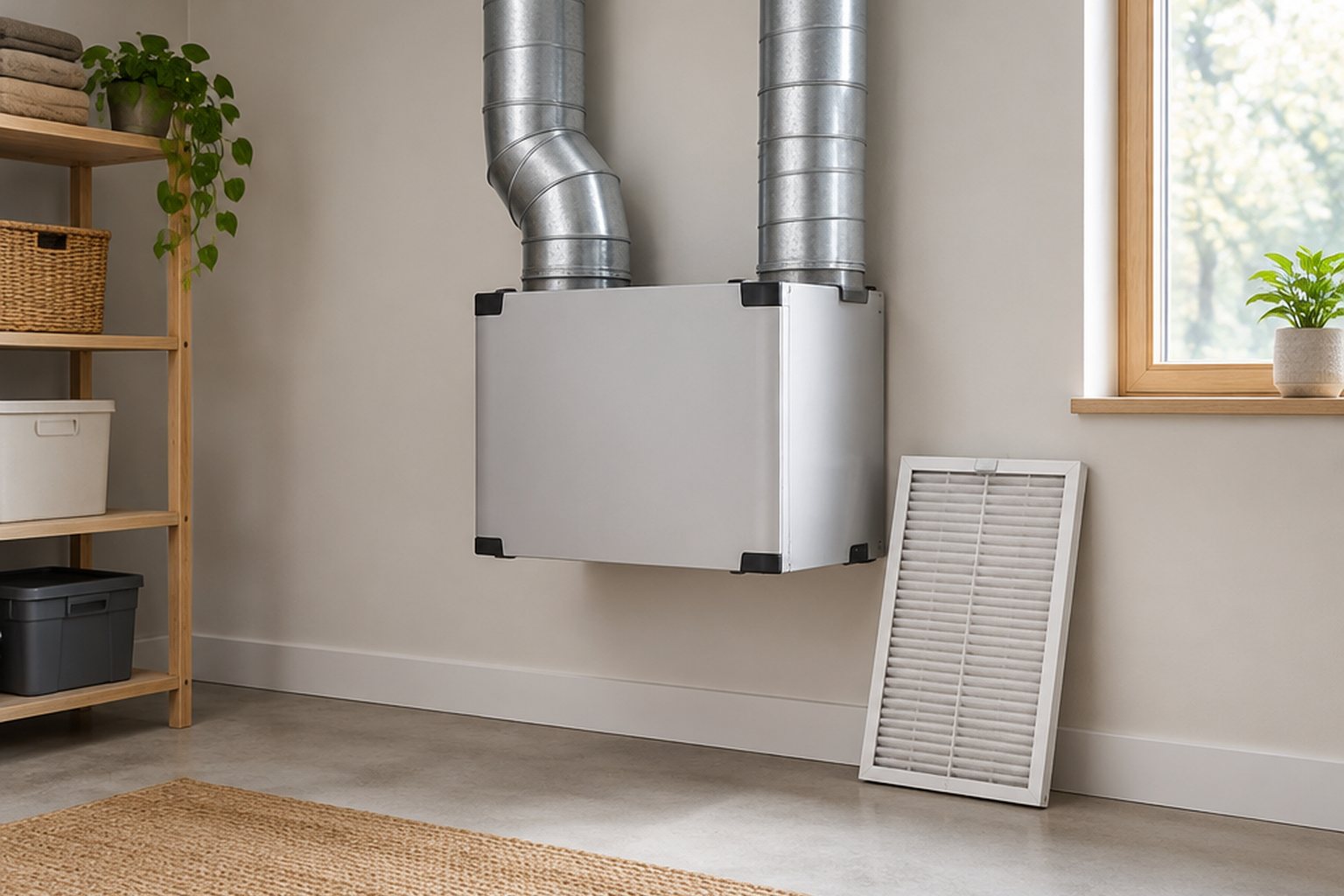
PNNL's existing-home ventilation guidance treats exhaust, supply and balanced arrangements as parts of a whole-building system. The useful lesson for a range hood is coordination. Replacement air is not merely a hole somewhere in the wall; its path, controls, comfort effects and relationship to other equipment need to be understood.
Include combustion and simultaneous operation
Where natural-draft combustion equipment exists, house pressure can be consequential. Have the appropriate professional assess the interaction with the proposed hood and other exhaust equipment. Do not rely on a homeowner promise never to run them together. The design should consider realistic use and any required safety verification.
PNNL's attic air-sealing checklist illustrates the importance of combustion-safety assessment when changing how a house exchanges air. It is not a range-hood sizing standard, but it supports the broader coordination question. A contractor should explain which tests or evaluations apply to your equipment and installation, rather than dismissing the issue because a similar hood worked in another house.
Ask about local rules without adopting internet thresholds
Online discussions often quote a specific airflow number at which makeup air becomes required. Such statements can depend on code edition, local amendments, equipment and exceptions. Ask the project professional to identify the applicable requirement and document the proposed compliance approach. This article does not establish one nationwide trigger.
Separate minimum compliance from performance goals. A design may need attention to comfort, odor capture or pressure interaction even where a particular prescriptive trigger does not apply. Conversely, a contractor should not sell an elaborate system without explaining why it is needed. The decision should rest on the actual installation and governing requirements, not a number detached from its context.
Compare complete retrofit options
For a hypothetical kitchen on an exterior wall, a short exhaust route may be straightforward while the replacement-air arrangement remains unresolved. An interior kitchen may have more difficult duct access but an existing ventilation system that changes the options. These are project-specific constraints. Ask each bidder to state what is included and what another trade must provide.
Compare capture geometry, airflow delivery, noise, replacement-air comfort, filtration and service access. Include electrical work and restoration of disturbed cabinets or finishes. A lower hood price can be misleading if the proposal excludes essential duct or control work. The useful comparison is the complete functioning kitchen ventilation system at the intended cooking conditions.
Verify the installed system and explain its use
At completion, confirm the specified hood, duct route, exterior termination and any makeup-air components. Ask for appropriate functional checks and relevant pressure or combustion verification. Controls that should operate together need to be demonstrated together. A test of the hood light and fan switch alone does not establish the performance of the full arrangement.
Provide occupants with operating and filter-maintenance instructions for the actual product. Record which settings are intended for different use conditions and what symptoms warrant service. Keep the design and test documentation with appliance records. A successful installation should make ordinary use practical, rather than depend on opening an arbitrary window or tolerating excessive noise whenever cooking produces a meaningful plume.
BEFORE YOU PROCEED
Your project checklist
- Identify the cooking appliance and intended capture arrangement.
- Confirm whether the product recirculates or exhausts outdoors.
- Review actual duct route and manufacturer requirements.
- Assess replacement-air and combustion interactions professionally.
- Document applicable local requirements instead of relying on a generic threshold.
- Verify coordinated controls and installed system performance.
Questions that come up next
Does every powerful range hood need the same makeup-air system?
No. The applicable rules and design depend on the installation and building. Ask for the local requirement and a project-specific assessment of replacement air, pressure and comfort.
Can I just open a window when using the hood?
Do not assume that an informal window-opening routine satisfies the design or applicable requirements. The responsible professional should specify an acceptable, reliable arrangement for the actual system.
EVIDENCE & SCOPE
Sources for this guide
Applies to: United States homeowner education. Climate, existing assembly, manufacturer instructions and locally adopted requirements govern project details; no nationwide code threshold is asserted.
Reddit discussions identify questions and experiences, not verified diagnoses or code requirements. Technical claims should be read with the linked primary source, product instructions and local requirements.
- Kitchen Exhaust Retrofit Duct Guidegovernment
Duct route, smooth metal duct, capture, makeup air and combustion interaction. Technical guidance; local requirements and product-specific details vary.
- Whole House Ventilation Strategies for Existing Homesgovernment
Exhaust, supply and balanced ventilation selection; interaction with existing HVAC. Technical guidance; local requirements and product-specific details vary.
- Attic Air Sealing and Insulationgovernment
Preconditions, moisture/ventilation assessment and attic insulation workmanship checks. Technical guidance; local requirements and product-specific details vary.
- Kitchen ventilation: Make-up air requirements are driving me crazy.reddit
An anonymized homeowner question that informed the article. Retrieved through search excerpts; anecdotal evidence, not a technical diagnosis.
- Range hood, hvac, makeup air, air purifierreddit
An anonymized homeowner question that informed the article. Retrieved through search excerpts; anecdotal evidence, not a technical diagnosis.