THE SHORT ANSWER
Neither vinyl plank nor engineered hardwood wins every kitchen. Compare the actual products against your household's spills, pets, appearance expectations and repair priorities. Vinyl's water resistance does not remove substrate requirements, and engineered wood's real-wood surface does not guarantee that it can be sanded. Installation conditions and the exact warranty matter as much as the showroom sample.
Decide which problems you are trying to avoid
The homeowner discussion behind this comparison involved one floor spanning several rooms. That is a different decision from choosing a surface for a small isolated kitchen. A continuous floor makes changes in material, height and appearance more consequential. It also connects rooms with different exposure: a dry living area, a refrigerator ice dispenser, a pet bowl and a laundry doorway.
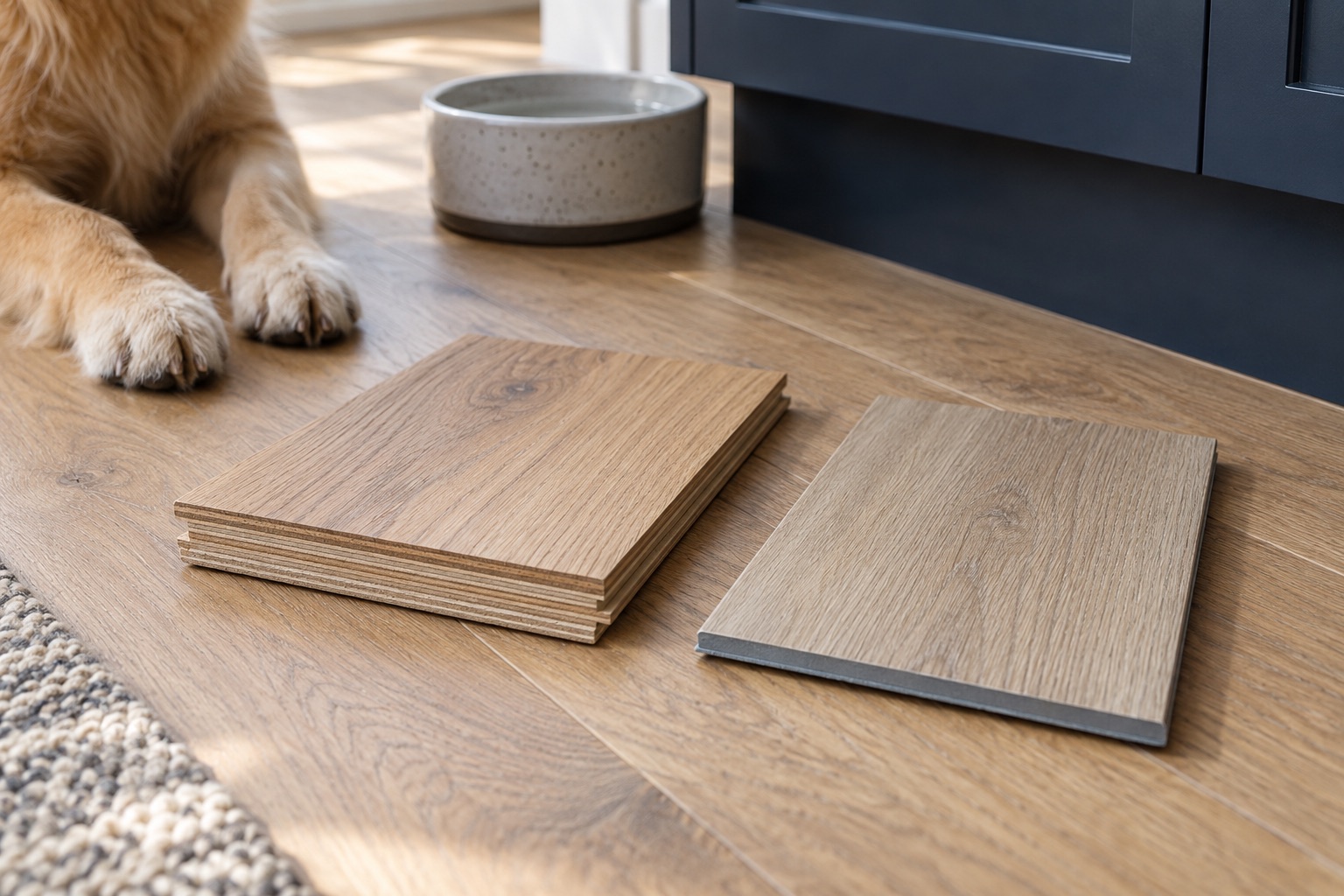
Write down the problems you actually experience. Dog nails may make visible scratches; grit tracked through an exterior door may abrade the finish; an unattended water bowl may expose joints repeatedly. These are different damage mechanisms. A product that performs well against one can disappoint against another. Rank your priorities before comparing samples, and decide which imperfections you can live with. Otherwise, a salesperson's strongest feature becomes your decision even when it does not address your household.
Read the construction rather than the category name
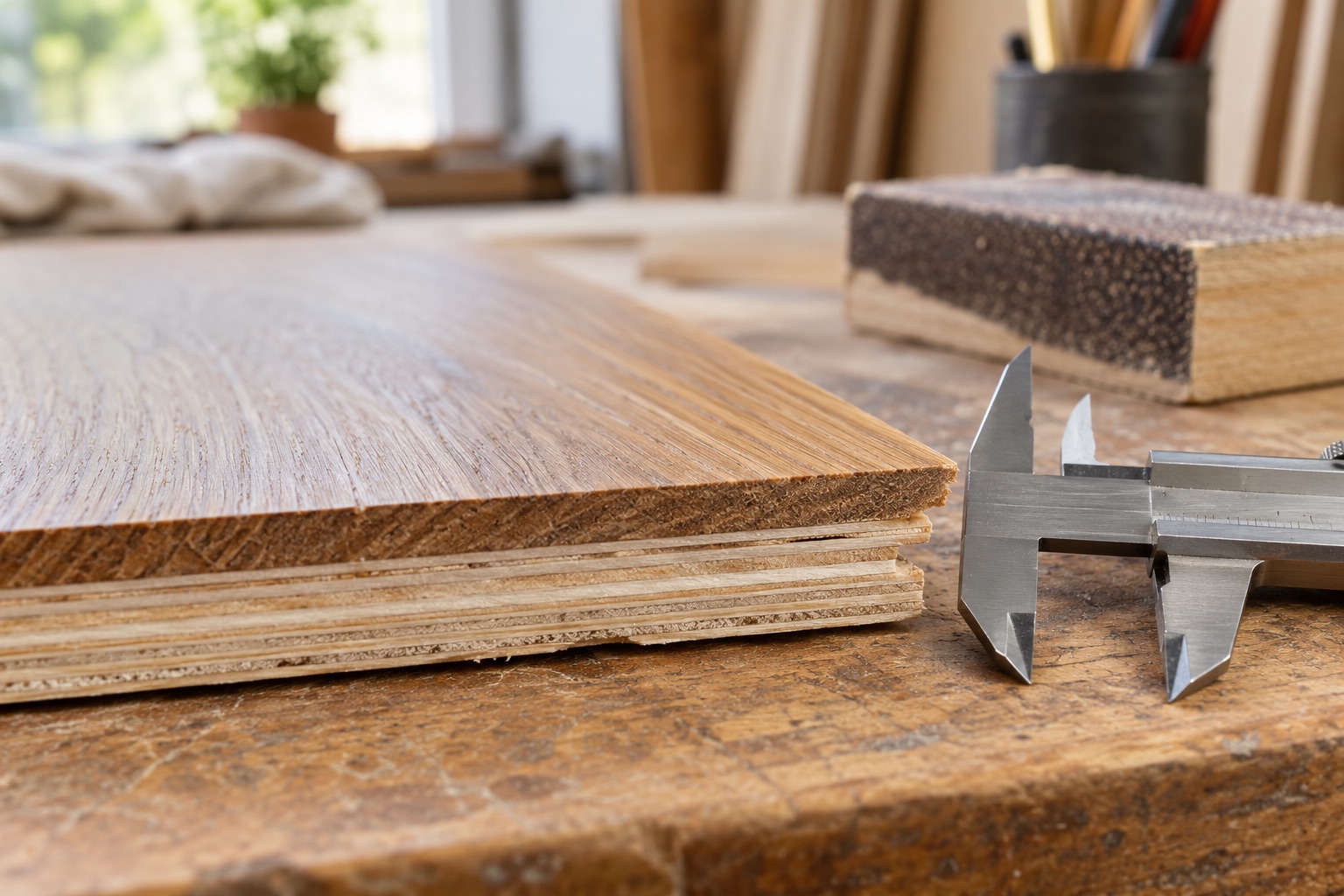
Engineered wood has a real-wood surface over a layered construction. Species, surface texture, finish and usable wood thickness vary. The National Wood Flooring Association's construction overview is a useful starting point, but the carton and technical documents must identify the product you are buying. The word engineered does not mean inexpensive, unsandable or universally suitable for wet locations.
Vinyl plank also covers different constructions and installation systems. Ask whether the proposed floor floats or is bonded, what substrate preparation it needs, and how damaged planks are replaced. Obtain a complete sample rather than judging a thin display chip. Look at edge shape, locking details and the pattern repeat. Two floors with similar wear-layer marketing can differ in stiffness, appearance and repair logistics. Save the model number so the installation guide cannot be silently replaced with instructions for another line.
| Decision factor | Engineered hardwood | Luxury vinyl plank |
|---|---|---|
| Surface wear | A wood face can dent or scratch; finish and grain affect visibility. | The wear layer can scratch; pattern and surface texture affect visibility. |
| Future repair | Recoating or sanding may be possible after construction and condition are verified. | Plan for individual plank replacement and keep matching spare material. |
| Water exposure | Wood movement and finish damage make moisture control important. | Water-resistant planks do not establish protection for the substrate or room perimeter. |
| Installation budget | Include the specified attachment method, substrate work and transitions. | Include flatness correction, approved underlayment and movement clearances. |
Compare scratches in the light you will live with
A hard finish, a scratch-resistant surface and an inconspicuous scratch are not the same thing. Dark uniform colors and glossy surfaces may reveal fine marks more readily than a varied matte appearance. Deep texture may disguise some marks while making cleaning less convenient. Consider that tradeoff when comparing heavily brushed wood with embossed vinyl.
View large samples by the actual windows and evening lights. Put them beside existing trim and cabinetry. Ask the supplier whether a sacrificial sample can be used to evaluate ordinary cleaning and visible marking; a home experiment is not a laboratory durability test. Keep pet nails maintained and use appropriate furniture protection regardless of material. NWFA's prevention guidance treats moisture and scratch protection as ongoing care, which is a more useful expectation than assuming any floor is pet-proof under every condition.
Treat spills and hidden moisture separately
A surface can tolerate a promptly cleaned spill while the installation below it remains vulnerable to water. A dishwasher leak can reach edges, penetrations or the substrate. Water-resistant advertising is not evidence that a floor can be left in service after a leak without inspection. Ask what the warranty excludes and what the installer would examine after water gets beneath the planks.
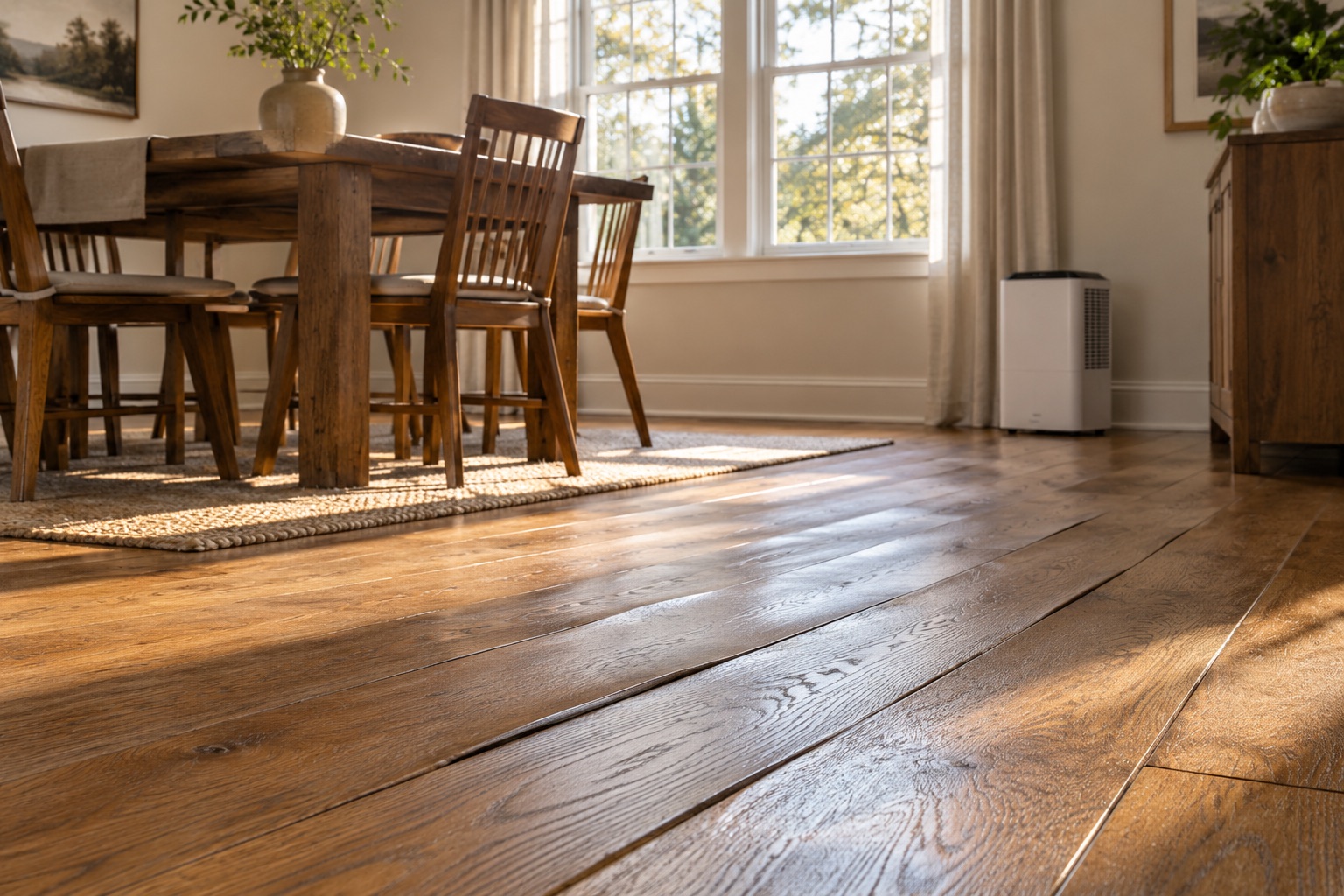
Wood can respond to moisture by changing dimension. That does not make every kitchen wood floor a bad choice, but it makes household behavior and environmental conditions relevant. Vinyl does not remove the need to evaluate a concrete slab or a damp wood subfloor. Shaw's SPC installation guidance calls for a suitable, flat, dry substrate. Its requirements are an example to compare against the exact product, not permission to apply one manufacturer's limits to another.
Price the complete installation
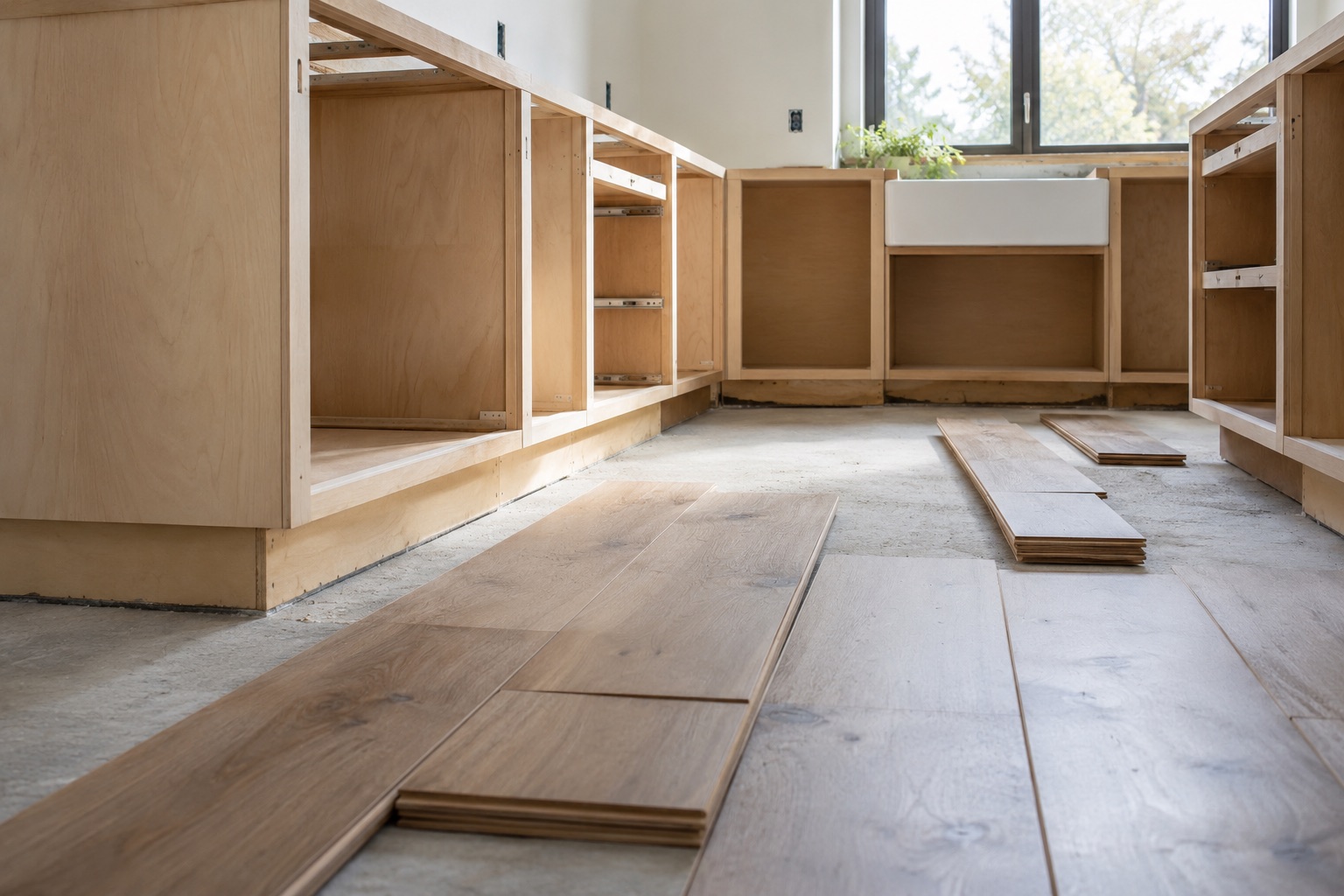
Compare quotations with the same scope. Removing existing flooring, correcting high and low areas, managing transitions, moving appliances and replacing trim can change the result more than a small difference in plank price. A low material quote may be paired with an unrealistic assumption that the substrate is ready.
Ask how flatness will be checked after demolition and how additional preparation will be documented. Include the dishwasher opening, refrigerator clearance and adjacent flooring height in that review. An added layer may leave an appliance difficult to remove later. For a hypothetical kitchen opening into a hall, a slightly more expensive flooring product that works with existing heights could be preferable to a cheaper product requiring several awkward transitions. That conclusion comes from the assembly and layout, not a general ranking of wood against vinyl.
Plan the repair before the first plank is installed
Ask for a written explanation of a likely repair. With a floating system, replacing one interior plank may require disassembly from an edge or a manufacturer-approved repair method. Bonded installations present different access and adhesive issues. Keep labeled spare material from the installation, but recognize that aging and sunlight can make a new spare look different later.
For engineered wood, distinguish a maintenance coat from sanding into the wood surface. The usable layer, existing texture and condition affect options. Do not buy on a promise that every engineered floor can be refinished a fixed number of times. Consider how disruptive the likely repair would be beneath connected rooms and fixed cabinetry. A household that values restoring a real-wood surface may accept its care requirements; another may prioritize replaceable planks and easier spill cleanup.
Make the decision with evidence you can keep
Before ordering, collect the product guide, care instructions, warranty, installation scope and a photograph of the chosen sample in your room. Mark which party is responsible for preparation, moisture evaluation and transitions. Resolve whether flooring runs beneath cabinets according to that product's instructions.
At completion, compare the installed surface with the approved layout and sample under normal lighting. Look for damaged joints, unusual movement, unfinished transitions and trim that restrains a floating floor. Keep the product identification and spare-plank location with the house records. The best choice is the one whose appearance, care and repair limitations you understand and whose installation requirements can actually be met. Online reports are helpful for discovering questions, but they cannot substitute for checking the particular floor and household.
BEFORE YOU PROCEED
Your project checklist
- Identify the exact construction, model and installation method.
- Compare large samples in the kitchen's daylight and evening light.
- Include substrate preparation and transitions in both quotes.
- Confirm moisture evaluation for the actual subfloor.
- Discuss a damaged-plank repair and keep matching spare material.
- Check appliance removal clearance after the new floor height.
Questions that come up next
Is vinyl plank automatically better for dogs?
No. Product construction, visible marking, grit control and installation quality vary; compare actual samples and care requirements.
Can every engineered floor be sanded later?
No. The remaining wood layer, texture, condition and previous work must be evaluated before sanding is promised.
EVIDENCE & SCOPE
Sources for this guide
Applies to: United States general material and workmanship guidance; selected-product instructions and applicable local requirements control.
Reddit discussions identify questions and experiences, not verified diagnoses or code requirements. Technical claims should be read with the linked primary source, product instructions and local requirements.
- NWFA: Problem Preventionstandard
Moisture-driven wood movement and scratch prevention. Industry guidance on moisture and surface wear; it does not diagnose a particular floor.
- NWFA: Types of Wood Floorsstandard
Solid versus engineered construction and potential refinishing. Indexed association text reviewed; refinishing potential depends on the actual wear layer and condition.
- Torn between LVP and Engineered Hardwoodreddit
Choosing one floor for multiple rooms while balancing appearance, durability and spill exposure. Search excerpt reviewed; the full discussion was not available during research. This is an individual homeowner account.
- Shaw: Resilient Installation Guidelines for SPC Productsmanufacturer
Flatness, substrate condition and floating rigid-core installation. Indexed manufacturer installation guidance reviewed; numerical requirements are product-specific.