THE SHORT ANSWER
A stud finder or wall scanner provides evidence, not a guarantee that a drilling path is safe. Different tools detect different features, and wall construction or conditions can produce missed or misleading readings. Use the exact model's instructions, repeat observations appropriately and corroborate them with reliable information. Stop when concealed services or support cannot be confidently located.
Know what your tool is actually detecting
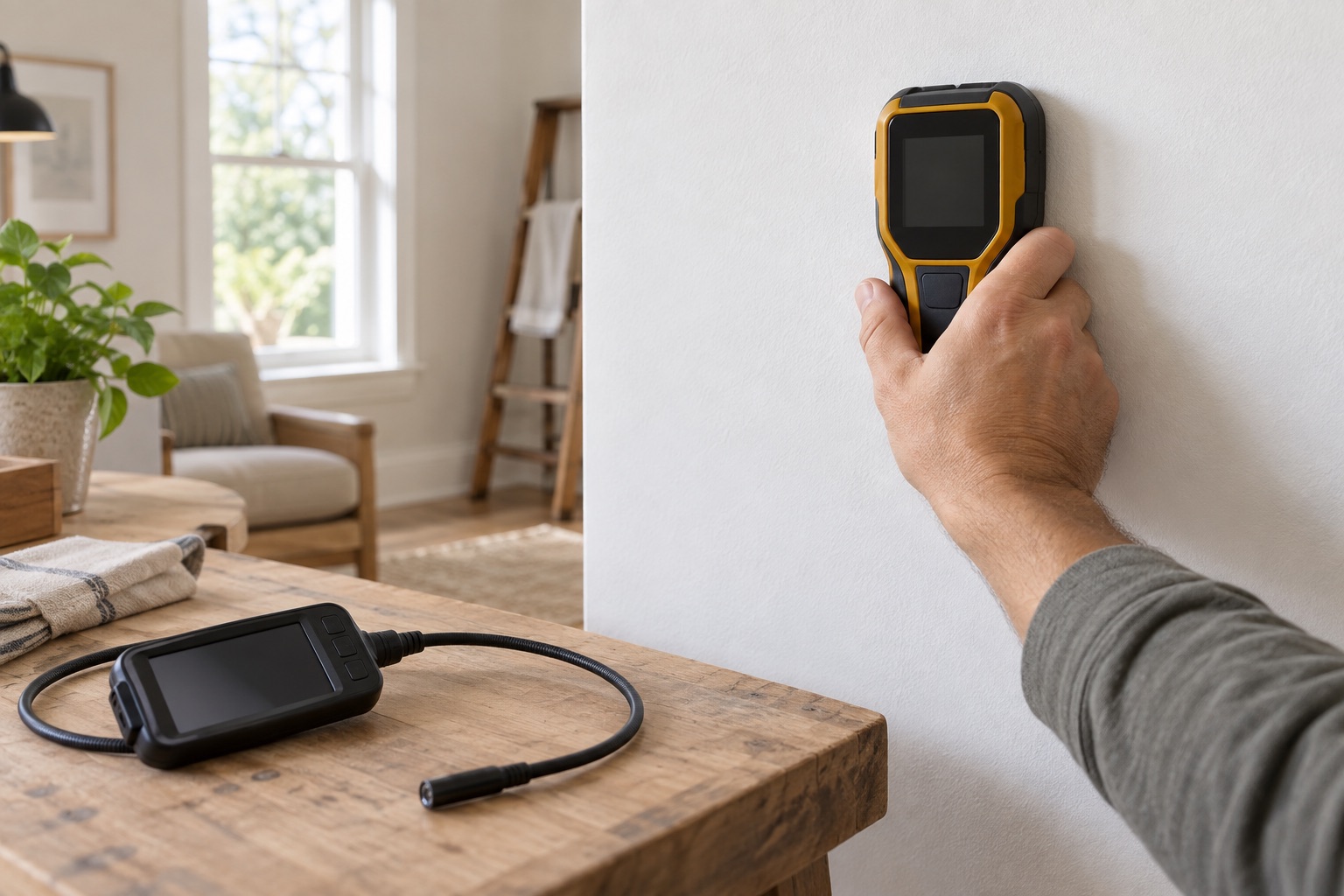
A magnetic finder responds to metal such as fasteners; an electronic stud finder may respond to changes in the wall assembly; other scanners use additional sensing methods. Their displays are not interchangeable. A line marked stud by one method does not automatically establish a solid safe fastening path through the entire depth.
The homeowner thread behind this article described a detector reporting possible live wiring across a broad area. That is a reason to interpret the reading, not ignore it or assume the whole wall contains the same hazard. Identify the tool model and read its operating instructions, including supported wall materials, modes and limitations. A borrowed scanner with an unfamiliar display can create more confidence than useful information if the user does not know what the symbols mean.
Start with the fastening task and wall construction
Define what is being installed, what support it requires and how deep the intended fastening must go. A light decorative item and a loaded cabinet need different attachment planning. The scanner does not decide whether the chosen fastener or substrate is adequate for the load.
Identify the wall type where possible: drywall, plaster, masonry, tile or a layered assembly can affect both detection and fastening. Existing drawings, construction photographs or an appropriately inspected accessible location can provide useful context. Do not assume a standard stud pattern applies to every wall or that a fastener found by a magnet proves the same clear path above and below it. The task should have an attachment plan suited to the actual construction before drilling becomes the default way to investigate.
Follow the model's setup and scan method
Detector instructions can specify calibration, contact, movement and operating modes. One Bosch detector manual describes conditions affecting live-wire detection, while another Bosch manual explains mode selection and signal interpretation. These are model-specific references; their procedures should not be copied blindly to a different instrument.
Use fresh or adequately charged batteries and inspect the tool as its instructions require. Select the correct mode and repeat the scan in the prescribed way. Mark observations lightly so conflicting readings remain visible rather than being forgotten. A single pass or one bright indicator should not settle the location. If the tool behaves inconsistently, stop and review setup and wall conditions before interpreting the most convenient reading as correct.
Understand misleading and missing indications
Wall coverings, moisture, metal layers and other conditions can affect detector behavior, depending on the technology. Some tools can indicate an object without reliably identifying every characteristic the user wants to know. A wide response may require more investigation rather than a precise mark at its center.
Most importantly, absence of a warning is not proof that no concealed service exists. A cable or pipe may be outside the tool's detection capability under the conditions present. Do not use a negative live-wire indication as permission to drill through an uncertain location. Likewise, changing conditions to make a warning disappear does not automatically establish a safe route. The decision needs corroborating evidence about the wall and intended path, not merely a display that eventually looks reassuring.
Corroborate without creating a new hazard
Compare repeatable scanner results with reliable construction information and observable features. Photos taken before the wall was closed can be valuable when their location is certain. An appropriately qualified person may inspect accessible spaces or use additional methods when the intended attachment warrants it.
Do not poke exploratory holes, drive nails or use longer screws just to see whether they hit wood when concealed services are uncertain. The first penetration is already an action with consequences. Also avoid treating a conventional vertical or horizontal route from a visible device as a guarantee of where all services run. Existing alterations can differ. If uncertainty remains, revise the attachment location or obtain qualified investigation. The proper response to an unexplained signal is a better information source, not a larger fastener.
Separate locating support from verifying the attachment
Once a support location is established, the fastener and mounting system still need to match the load and construction. Follow the fixture and anchoring manufacturer's requirements. A scanner does not verify the condition of the support, the strength of an anchor or the suitability of the wall for a heavy item.
For a hypothetical wall cabinet, confirming a likely stud line is only one part of the installation. The installer must also coordinate cabinet rails or fastening points, support condition and concealed services. A lighter object may have an approved alternative anchoring method, but that method still has limits. Do not combine a scanner result with an unrelated online fastener recommendation and assume the two establish a complete design. Keep responsibility for the attachment clear.
Create records that make future work easier
If a wall is open during remodeling, photograph and dimension framing, reinforcement and service routes before it is covered. Include enough fixed reference points to locate the information later. Store those records with the room plan and note any subsequent changes.
Before drilling into a finished wall, record the method used to establish the location and the approved attachment detail where the task warrants it. Stop if the actual conditions differ from the plan. For significant loads or uncertain services, qualified installation can be the more practical route. A stud finder is useful because it contributes information quickly, but its value depends on understanding its limits. The safe decision comes from a coherent picture of the wall and task, not from treating one tool's signal as a guarantee.
BEFORE YOU PROCEED
Your project checklist
- Identify tool technology, model and supported wall materials.
- Define the fixture load and intended penetration depth.
- Follow the exact calibration, mode and scanning instructions.
- Treat negative service detection as inconclusive when uncertainty remains.
- Corroborate readings without exploratory blind penetrations.
- Verify the mounting system separately from locating support.
Questions that come up next
Can I drill wherever the wire warning is off?
No. A negative indication does not prove that the intended path is free of concealed services.
Does a magnet prove I found a safe stud location?
It locates metal, often a fastener. Support identity, service location and attachment suitability still need verification.
EVIDENCE & SCOPE
Sources for this guide
Applies to: United States general material and workmanship guidance; selected-product instructions and applicable local requirements control.
Reddit discussions identify questions and experiences, not verified diagnoses or code requirements. Technical claims should be read with the linked primary source, product instructions and local requirements.
- Bosch Detector Operating Instructions 160992A7ZFmanufacturer
Live-wire detection conditions and surface interference. Indexed model-specific operating manual reviewed; a negative indication does not establish a safe drilling path.
- Bosch Detector Operating Instructions 160992A7KZmanufacturer
Wall-material modes, signal interpretation and localization. Indexed model-specific operating manual reviewed; supported materials and detection limits vary by tool.
- stud finderreddit
A detector marks a large wall area as live wiring and the owner cannot distinguish interference from a hidden hazard. Search excerpt reviewed; the full discussion was not available during research. This is an individual homeowner account.