THE SHORT ANSWER
Evaluate the cabinet as a complete product. Panel material matters, but so do thickness, edge treatment, joinery, shelf span, hardware attachment and installation. Plywood is not a guarantee of good construction, and a composite panel is not proof of failure. Compare documented performance and the actual components, while treating emissions compliance and moisture durability as separate questions.
Ask which part is made from which material
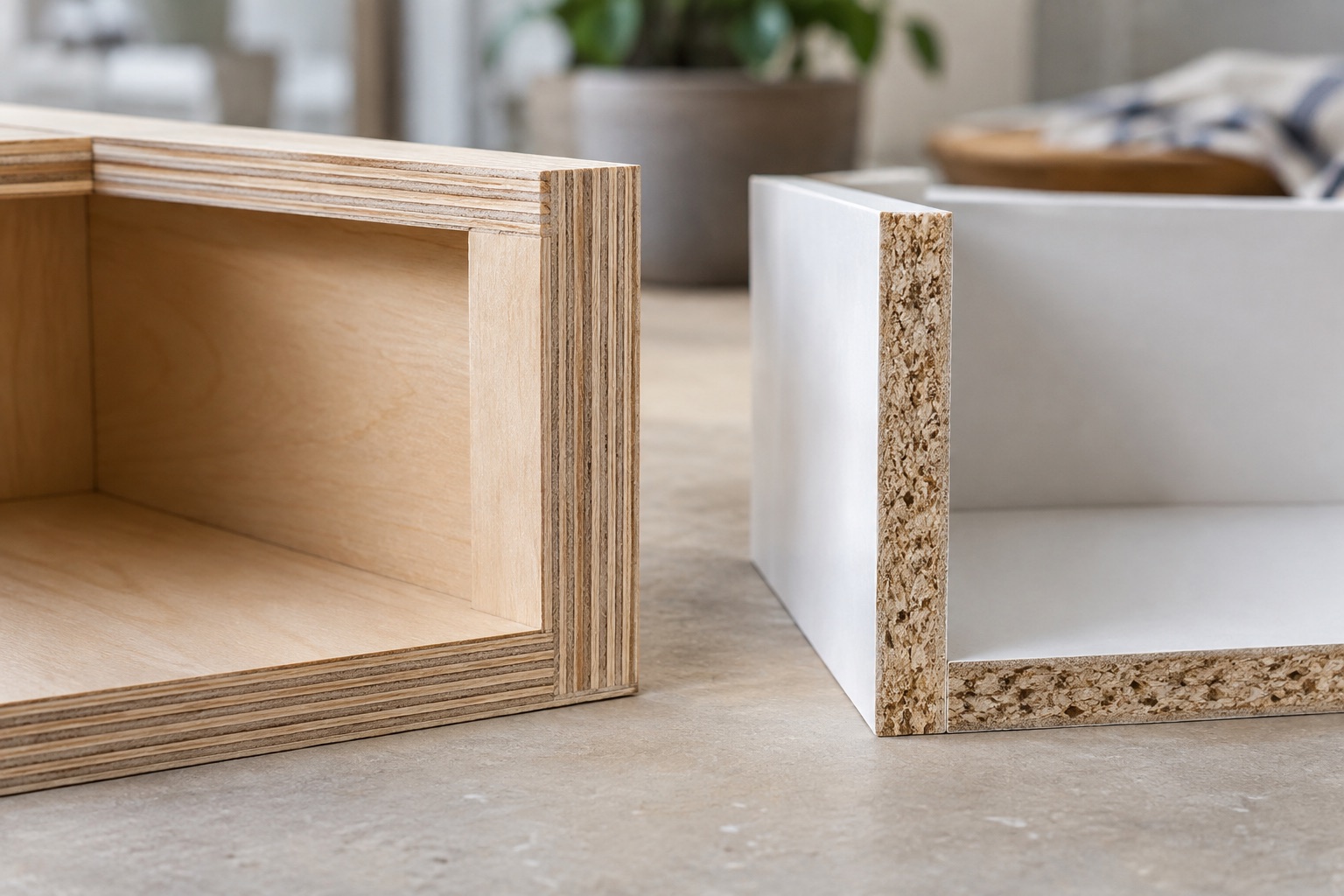
A cabinet can use one material for the box, another for shelves and another for door panels. The phrase all wood may obscure those differences. Get a component list that identifies sides, backs, bottoms, shelves, drawer boxes, face frames and fronts. Look at an assembled sample as well as a cutaway.
The particleboard-versus-plywood discussion involved a builder trying to sort through sweeping online rankings. A second homeowner thread focused specifically on water damage beneath a sink. Both show why one material word is too blunt a comparison. A strong drawer system in a well-built composite box may address a household's needs better than poorly joined plywood with inadequate hardware. The useful question is how the chosen material is used and protected in the actual cabinet.
Compare construction details you can inspect
Examine panel edges, corner joints, back attachment and the way the cabinet will be secured. Check whether exposed edges are finished and whether fasteners have a well-supported attachment. A showroom door can feel substantial while the box behind it has details you have not seen.
Ask how the manufacturer handles long spans, wide drawers and heavily loaded cabinets. The same panel can perform differently depending on its dimensions and support. Do not equate a thicker panel with a complete engineering assessment, but do ask for a clear explanation of the construction. A sample cabinet should allow you to inspect the inside and rear, not just the decorative front. Photograph the specific product and options quoted so a later delivery can be checked against them.
Use performance evidence appropriately
KCMA's quality certification program evaluates structural behavior, drawer and door operation, and finish performance. That is more informative than a general claim that one sheet material always lasts longer. If certification is part of the sales claim, confirm that it applies to the actual manufacturer, line and configuration offered.
Certification is not a promise that abuse, unresolved leaks or improper installation cannot cause damage. It also does not tell you whether a cabinet's dimensions and storage layout suit your kitchen. Use performance documentation alongside physical inspection and the installation plan. Ask what the manufacturer warrants and what conditions are excluded, then keep the relevant documents. A premium material label should not be allowed to substitute for evidence about the complete product or a practical plan for mounting it securely.
Treat the sink cabinet as a moisture-management problem
A cabinet under a sink deserves attention because leaks can reach hidden surfaces and edges. Identify the proposed bottom, edge treatment and access for inspecting plumbing connections. Consider how a small leak would become visible before it affects adjacent materials. An accessory tray can help contain a minor spill, but it should not conceal ongoing leakage.
Do not assume plywood makes leak investigation unnecessary or that every composite box will immediately fail. Ask the manufacturer about the product's intended exposure and care. If a cabinet has already swollen or delaminated, covering it with a new surface may hide a condition that still needs assessment. For a hypothetical flat-pack kitchen, choosing a different sink-base construction may be useful, but only if the joints, support and surrounding installation are also resolved.
Evaluate shelves, drawers and hardware together
Storage loads are carried through shelves, slides, hinges and their attachments. Test how drawers operate with a representative load when the showroom permits it. Ask about adjustment, replacement parts and access to the hardware after installation. A smoothly closing empty drawer does not answer every durability question.
Check the width and depth of shelves and whether additional support is needed for the planned contents. Door size and hinge arrangement affect how the front behaves. Look for practical serviceability: can a worn slide be replaced, and are the mounting locations robust enough for adjustment? Compare these details across similarly configured cabinets. Otherwise, a plywood quote with basic hardware may be compared unfairly with a composite-panel quote that includes a more useful drawer system and storage arrangement.
Keep emissions documentation separate
EPA's consumer guidance on composite wood products explains the relevant product categories and emissions requirements. Kitchen cabinets may contain regulated composite wood even when some components are solid wood or plywood. Ask for the applicable documentation and labeling rather than assuming a marketing term settles the issue.
Emissions compliance does not certify resistance to water or the quality of joinery. Likewise, a cabinet described as plywood is not automatically free of adhesives or emissions considerations. Keep these questions separate in your comparison: what the product is made from, how it performs structurally, how it is finished and what emissions requirements it meets. This avoids paying for a construction upgrade while mistakenly believing it answers an unrelated indoor-air concern.
Check the delivered product before installation
Compare the shipment with the approved specification, including any upgraded construction. Inspect damaged edges, loose joints, misaligned holes and finish defects before the boxes are covered by countertops or fixed in place. Document discrepancies with product labels and photographs rather than relying on memory of the showroom sample.
Have the installer check wall and floor conditions so the cabinets can be mounted, leveled and supported appropriately. Poor installation can undermine a well-made box. At completion, inspect doors, drawers, shelves and exposed panels under ordinary use, then retain hardware and care information. The best comparison is a clear list of components, performance evidence and installation details. That approach makes material choices meaningful without turning plywood, MDF or particleboard into a universal verdict.
BEFORE YOU PROCEED
Your project checklist
- Request materials for every cabinet component.
- Inspect joints, backs, edges and mounting details.
- Verify any certification applies to the quoted line.
- Plan sink-base leak visibility and inspection access.
- Compare shelf spans and hardware under realistic use.
- Keep emissions documentation separate from durability claims.
Questions that come up next
Are plywood cabinets always better?
No. Panel quality, construction, hardware and installation can outweigh the material label alone.
Does emissions compliance make a cabinet waterproof?
No. Emissions requirements and moisture performance address different characteristics.
EVIDENCE & SCOPE
Sources for this guide
Applies to: United States general material and workmanship guidance; selected-product instructions and applicable local requirements control.
Reddit discussions identify questions and experiences, not verified diagnoses or code requirements. Technical claims should be read with the linked primary source, product instructions and local requirements.
- EPA: Composite Wood Product Consumer Questionsgovernment
Composite wood categories, finished products and emissions labeling. US federal emissions guidance; emissions compliance is separate from moisture resistance.
- KCMA A161.1 Quality Cabinet Certificationstandard
Cabinet structural, drawer, door and finish testing. Certification describes whole-cabinet performance testing, not a ranking of panel materials.
- Particleboard vs plywood for kitchen cabinetsreddit
DIY cabinet builder sees sweeping material rankings and wants to understand actual construction tradeoffs. Search excerpt reviewed; the full discussion was not available during research. This is an individual homeowner account.
- Kitchen cabinets and water damage..?reddit
Flat-pack cabinets seem economical but the household worries about moisture damage, especially under the sink. Search excerpt reviewed; the full discussion was not available during research. This is an individual homeowner account.