THE SHORT ANSWER
Choose a countertop by its documented material, treatment and care requirements, then compare the actual slab or product. Engineered quartz and natural quartzite are different materials despite similar names. Neither natural stone nor engineered surfaces are indestructible. Heat precautions, staining, cleaning, seams and repair expectations should match how your household cooks and maintains the kitchen.
Confirm the material identity
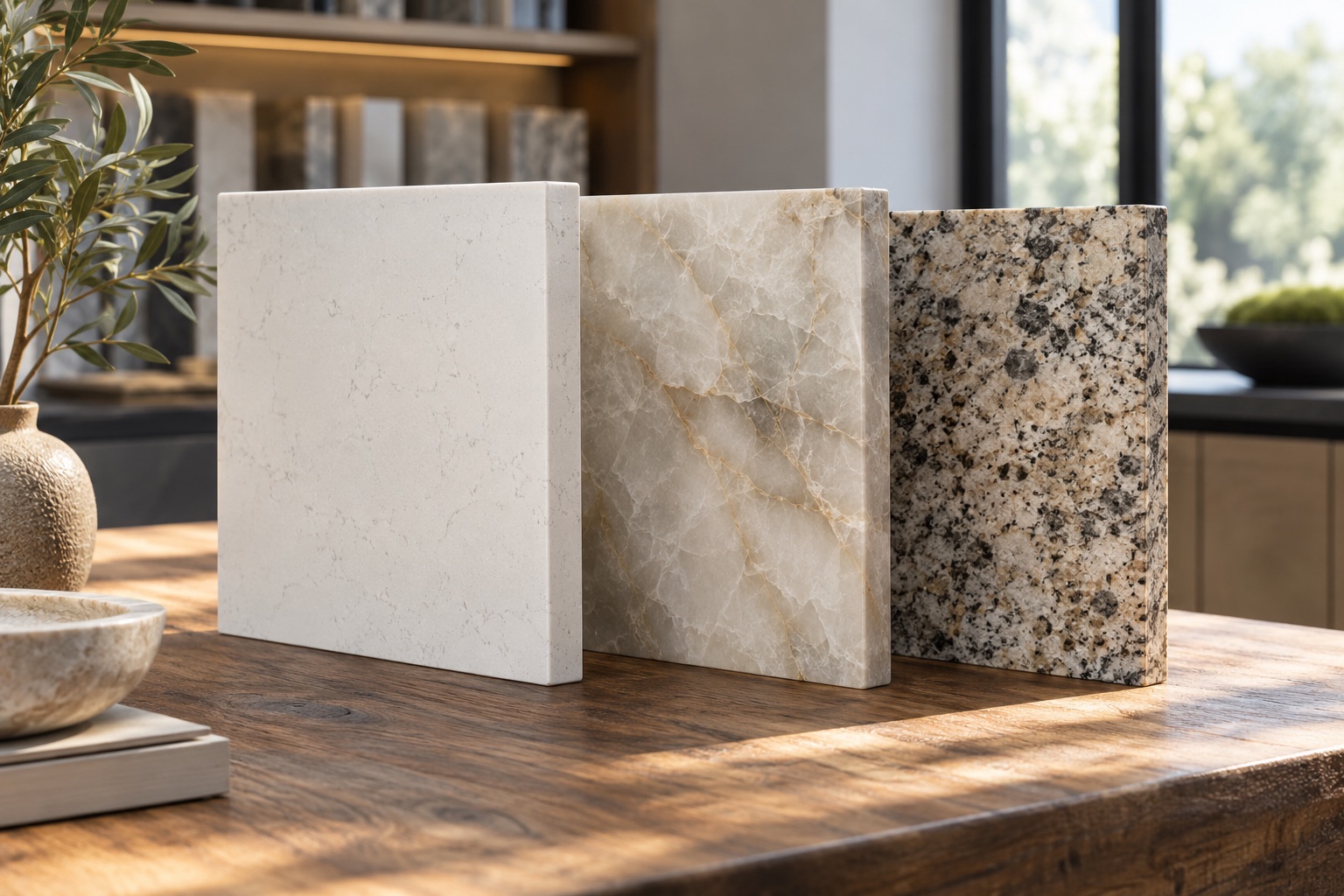
Names can create confusion before any practical comparison begins. Engineered quartz is a manufactured surface, while quartzite and granite refer to natural stone categories. Commercial slab names may emphasize appearance rather than explaining all relevant properties or treatments. Ask the supplier to identify the actual material and provide care information for the product offered.
The quartz-or-quartzite discussion behind this article illustrates how shoppers encounter conflicting durability claims. Avoid treating a category name as a complete specification. Record the manufacturer and color for an engineered product, or the slab identification and supplier information for natural stone. If a material is being sold with an unusual performance claim, ask what supports it. The answer should describe the actual product rather than repeat that stone is natural or quartz is maintenance-free.
| Decision factor | Engineered quartz | Quartzite | Granite |
|---|---|---|---|
| Material identity | Manufactured surface; obtain the exact product and care guide. | Natural stone; verify the slab identification rather than relying only on a sales name. | Natural stone; evaluate the actual slab and finish. |
| Heat practice | Use protection consistent with manufacturer instructions. | Obtain care advice for the stone, treatment and fabricated assembly. | Obtain care advice for the stone, treatment and fabricated assembly. |
| Stain and cleaning questions | Check approved cleaners and treatment of persistent marks. | Assess the actual surface and any sealer or treatment requirements. | Assess the actual surface and any sealer or treatment requirements. |
| Appearance approval | Confirm the selected pattern, finish and seam layout. | Review the full slab and vein placement around cutouts. | Review the full slab and variation around seams and cutouts. |
Compare heat habits, not heatproof slogans
A household that routinely moves hot cookware onto the counter needs a deliberate protection plan. Caesarstone's care guidance calls for protection beneath hot cookware on its quartz and mineral surfaces. Natural stone also deserves appropriate care; thermal stress, finishes, treatments and the particular assembly make broad heatproof claims unhelpful.
Plan convenient locations for trivets or heat-protective surfaces where cooking actually happens. A precaution that is awkward to use will often be ignored. Ask the fabricator about the selected material near appliances and concentrated heat sources. Do not perform an extreme heat test on a showroom sample and assume it establishes the warranty or behavior of a finished top. The useful comparison is whether the required care fits your habits, and whether the kitchen layout makes that care easy.
Separate staining, etching and surface residue
A mark can come from absorbed material, a chemical reaction or residue left on the surface. Those mechanisms may require different responses. Before treating a mark aggressively, identify the material and follow the supplier's care instructions. A cleaner that removes one deposit can damage another surface.
The Natural Stone Institute's care guidance distinguishes stone types and cleaning considerations, including the role of impregnating sealers. A sealer should not be described as making every stone impervious to every substance. Ask what maintenance the particular slab needs and how to recognize when attention is required. For engineered surfaces, use the named manufacturer's instructions rather than a generic stone-cleaning recipe. Consider whether household cleaners already in use are compatible with the planned top and nearby grout, caulk and finishes.
Evaluate the actual slab or a meaningful product sample
Natural stone can vary within a slab and between slabs. Engineered patterns also have layouts and repeats that affect the final appearance. View enough material to understand how the countertop will look at full scale, including changes across an island or long run.
Discuss seam placement and pattern direction before cutting. A small sample may not show a prominent vein that will cross a sink cutout or become visually interrupted at a seam. Ask the fabricator to explain any material features that influence fabrication or handling. If testing a sample for ordinary stains is proposed, use an agreed method and understand its limits; a home sample trial is not a comprehensive performance certification. Keep photographs of the approved material and layout so acceptance is based on a shared reference.
Include edges, cutouts and support in durability
Countertop performance depends on more than the broad flat surface. Sink openings, narrow sections, edges and overhangs introduce fabrication and support questions. An attractive material selected without a feasible support plan can create a problem that no care routine will solve.
Ask how the chosen thickness, edge profile and cabinet arrangement will be coordinated. Avoid comparing unsupported-overhang numbers from unrelated materials or brands. The fabricator should identify the appropriate requirements for the actual slab and design. Consider ordinary use at the edges: seating, children climbing, heavy appliances and impacts all matter, but the counter should not be treated as a seat or work platform unless specifically designed for that use. The decision should include a complete installation plan, not just a price per unit of surface area.
Think about repair and visible aging
Ask what a likely repair would look like. A small chip, persistent stain or cracked section may have different repair options depending on the material and location. An available repair does not necessarily mean an invisible one. Matching color, sheen and pattern can be difficult, especially after the surrounding surface has aged.
Discuss whether the supplier can retain material information or offcuts where useful, and what care products will be needed. A hypothetical household that accepts natural variation but dislikes any maintenance may have conflicting priorities to resolve. Another may prefer consistent patterning but need to change a habit of setting hot pans directly on the counter. Neither choice is inherently wrong. The stronger decision recognizes the compromise before the material becomes an expensive fixed part of the kitchen.
Approve care and fabrication together
Before fabrication, confirm the material identity, selected slabs or pattern, edge detail, seams, cutouts and support responsibilities. Read the care and warranty documents while you can still change the decision. Clarify which claims apply to the surface and which depend on installation or use.
At completion, inspect the material against the approved layout and review care instructions with the household. Check seams, edges and supports separately from cosmetic color variation. Keep product identification and supplier records for future repairs. Do not choose solely on a claim that one category never stains, never burns or never needs attention. A countertop is a good fit when its real limitations are compatible with your kitchen and its fabrication and support are planned with the same care as its appearance.
BEFORE YOU PROCEED
Your project checklist
- Record actual material, manufacturer or slab identity.
- Read heat and cleaning requirements before choosing.
- Distinguish staining from etching and residue.
- Approve full-scale pattern and seam placement.
- Coordinate edges, cutouts and support with the fabricator.
- Discuss likely repair appearance and retain product records.
Questions that come up next
Are quartz and quartzite the same?
No. Engineered quartz is manufactured; quartzite is natural stone. Verify the material actually being sold.
Does sealing make natural stone stainproof?
Do not assume that. Follow the selected stone and sealer guidance and maintain appropriate spill and cleaning habits.
EVIDENCE & SCOPE
Sources for this guide
Applies to: United States general material and workmanship guidance; selected-product instructions and applicable local requirements control.
Reddit discussions identify questions and experiences, not verified diagnoses or code requirements. Technical claims should be read with the linked primary source, product instructions and local requirements.
- Caesarstone: Quartz and Mineral Surface Caremanufacturer
Heat precautions, cleaning, stain care and daily use. Manufacturer care guidance for its surfaces; natural-stone care can differ.
- Quartz or Quartzite?reddit
Countertop shopper compares engineered quartz and natural quartzite, including heat and durability claims. Search excerpt reviewed; the full discussion was not available during research. This is an individual homeowner account.
- Natural Stone Institute: Care and Cleaning of Natural Stonestandard
Stone identification, cleaners, staining and impregnating sealers. Natural-stone industry guidance; individual stone, finish and treatment affect care.